| | Boletim de Notícias do DF #10(English version here) | |
|
|
|
| | IST-PhysFront’25O 1.º Simpósio IST-Physics Frontier (IST-PhysFront’25) teve lugar no dia 10 de setembro de 2025, no Técnico Innovation Center (TIC), reunindo estudantes, investigadores e docentes num dia inteiramente dedicado à investigação de fronteira em Física. Organizado pelo DF, pela coordenação LEFT/MEFT e pelo NFIST, o evento marcou o início do que se espera ser uma tradição anual que pretende celebrar a Física e a Engenharia feitas no DF e promover o encontro entre diferentes áreas e gerações. Esta primeira edição teve como tema central “Machine Learning em Física”, refletindo o impacto crescente da inteligência artificial na forma como os físicos simulam, medem e compreendem o mundo natural. 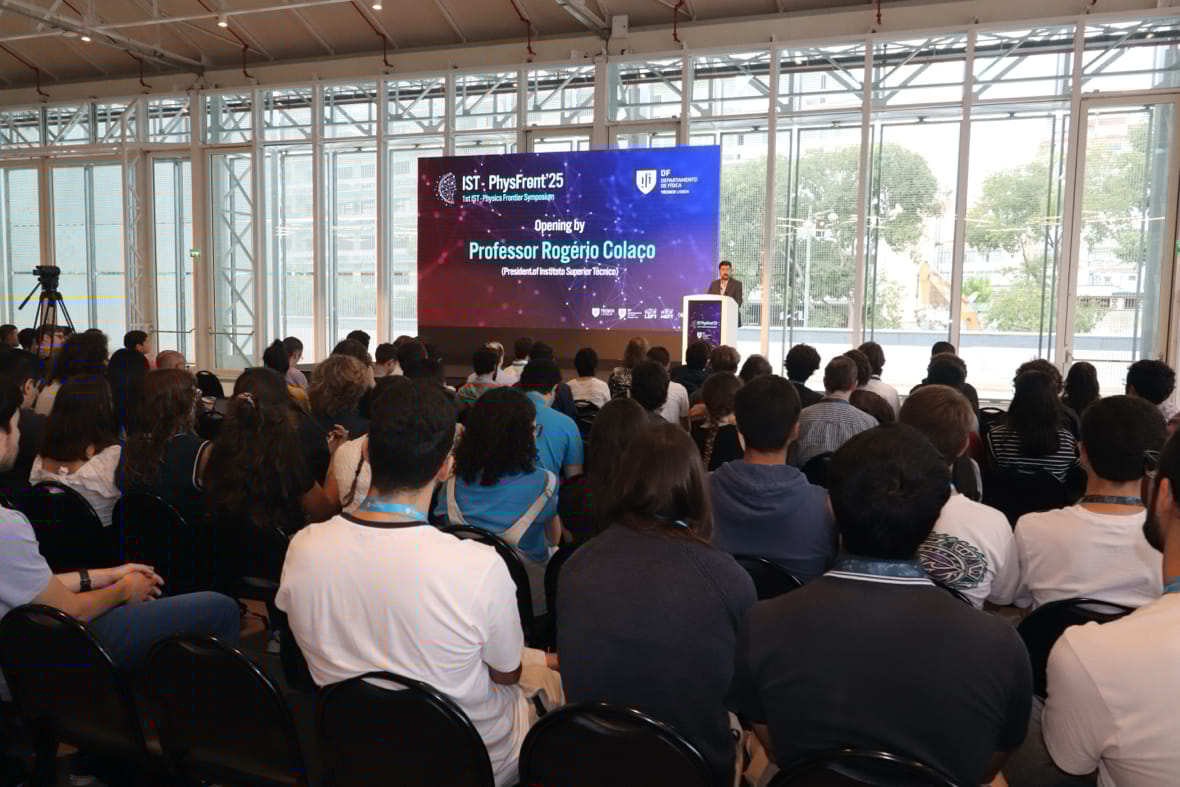
Professor Rogério Colaço (Presidente do IST) na abertura do PhysFront’25 A sessão temática da manhã contou com um painel que abordou a aplicação da inteligência artificial em múltiplos domínios da Física. Frederico Fiúza abriu o programa com “The AI Physicist: learning equations from data”, seguido de Susana Freitas, que apresentou “Decoding Touch: Machine Learning and Spintronic Sensors Beneath Magnetic Skins”. Giuseppe De Tomasi explorou o papel do machine learning em sistemas quânticos fora do equilíbrio, Vasco Guerra abordou a importância da coerência física nos modelos de aprendizagem automática, Rúben Conceição destacou a utilização da IA em experiências de astropartículas, e Marco Piccardo encerrou com “Optics that learn”, sobre óptica adaptativa e sistemas inteligentes. Durante a tarde, a Research Highlight Session deu palco a alguns dos temas mais amplos da investigação feita no DF-IST. Andreas Trautner, Liliana Apolinário, Marta Fajardo e Richard Brito apresentaram trabalhos que vão das simetrias fundamentais na teoria quântica de campos às colisões hadrónicas, da interação de lasers intensos com a matéria às ondas gravitacionais e à relatividade como ferramenta para sondar novos regimes da física fundamental. Um dos momentos mais inspiradores foi o das Outstanding Student Talks, em que quatro jovens investigadores apresentaram os seus projetos. Duarte Lopes (LEFT) falou sobre mecanismos de injeção de partículas em choques astrofísicos, Gonçalo Roriz (LEFT) apresentou o desenvolvimento de eletrónica ultrarrápida para radioterapia FLASH, Mariana Abreu (MEFT) discutiu transições de fase em sistemas quase-periódicos e Gonçalo Martins (MEFT) abordou as implicações cosmológicas das diferenças entre galáxias hospedeiras de supernovas e a tensão na constante de Hubble. 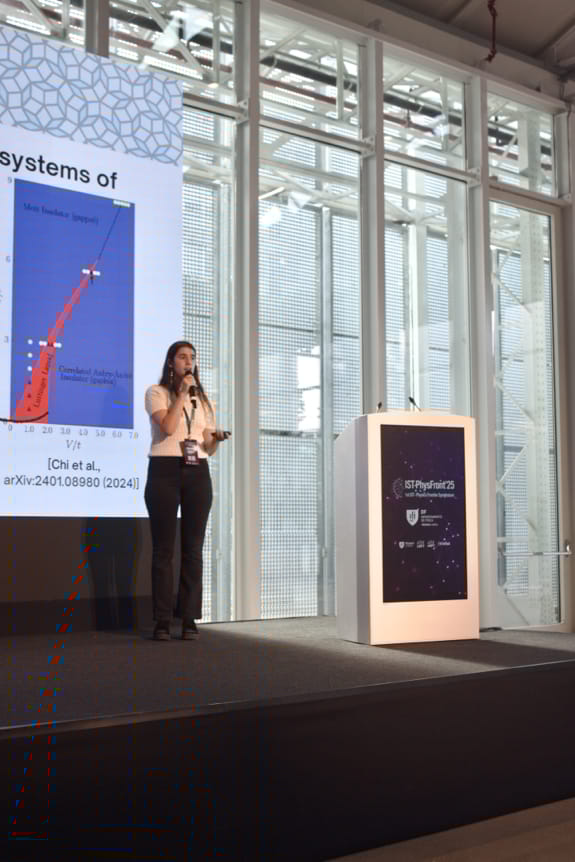 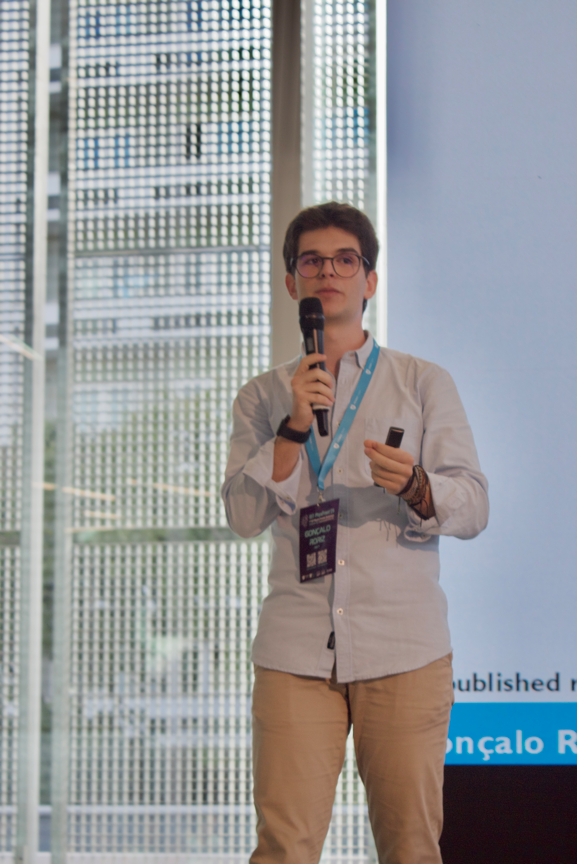
Mariana Abreu (MEFT) e Gonçalo Roriz (LEFT) 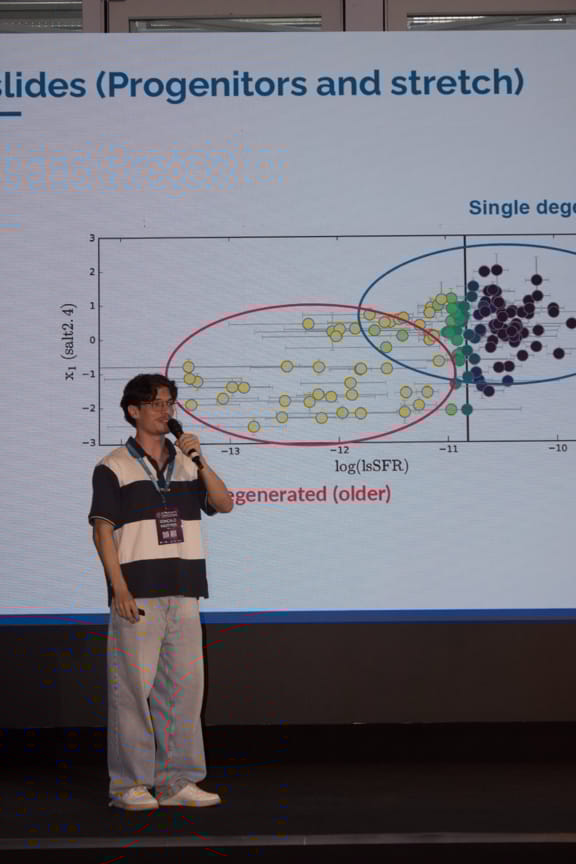 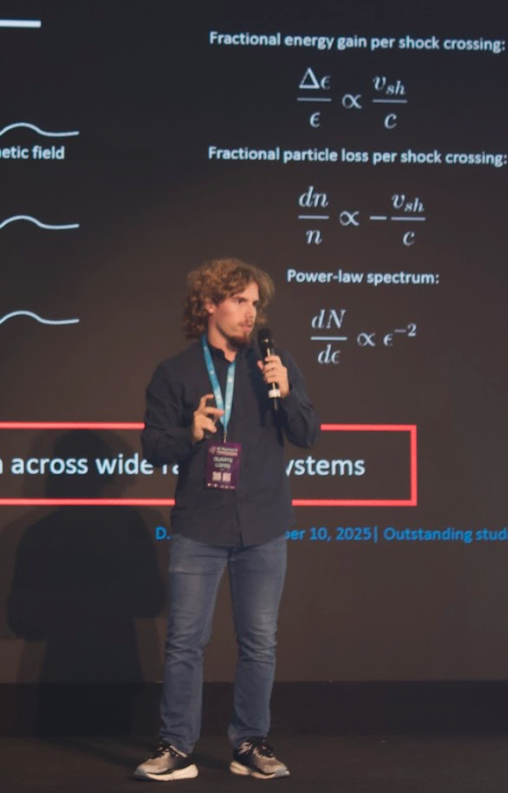
Gonçalo Martins (MEFT) e Duarte Lopes (LEFT) Ao longo do dia, as sessões de póster encheram o átrio do TIC com entusiasmo e troca de ideias entre estudantes dos três ciclos – LEFT, MEFT e doutoramento. Os trabalhos apresentados abrangeram temas tão diversos como física de partículas, astrofísica, óptica quântica, sensores e materiais avançados. O público votou nos seus posters favoritos, e os prémios foram anunciados no final do dia: Inês Alvito e Carolina Antunes venceram na categoria LEFT, com os posters Sensitivity of Shower Footprint
Variables to High- and Low-Energy
Hadronic Interaction Models e Wireless Triboelectric Wearable Sensors for Self-Powered Biomechanical Monitoring 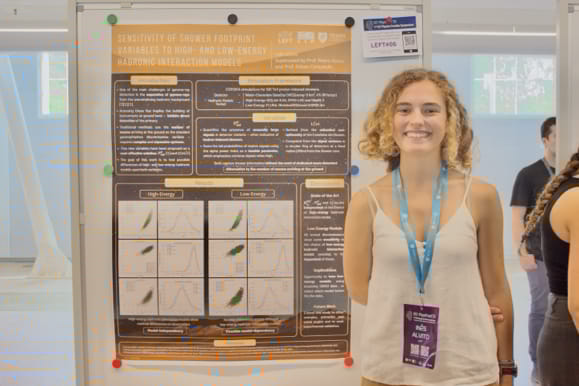 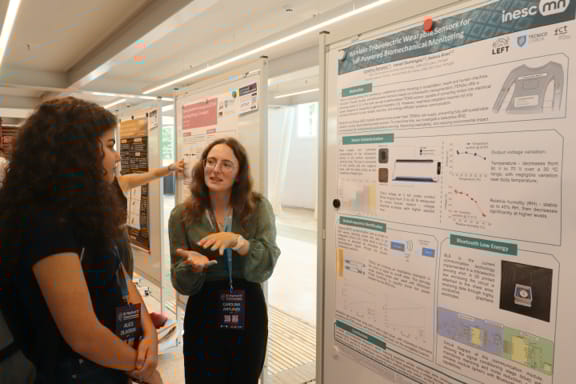
Bernardo Picão foi distinguido na categoria MEFT com o poster Got to bind them all! Computing tetraquark potentials on the lattice, 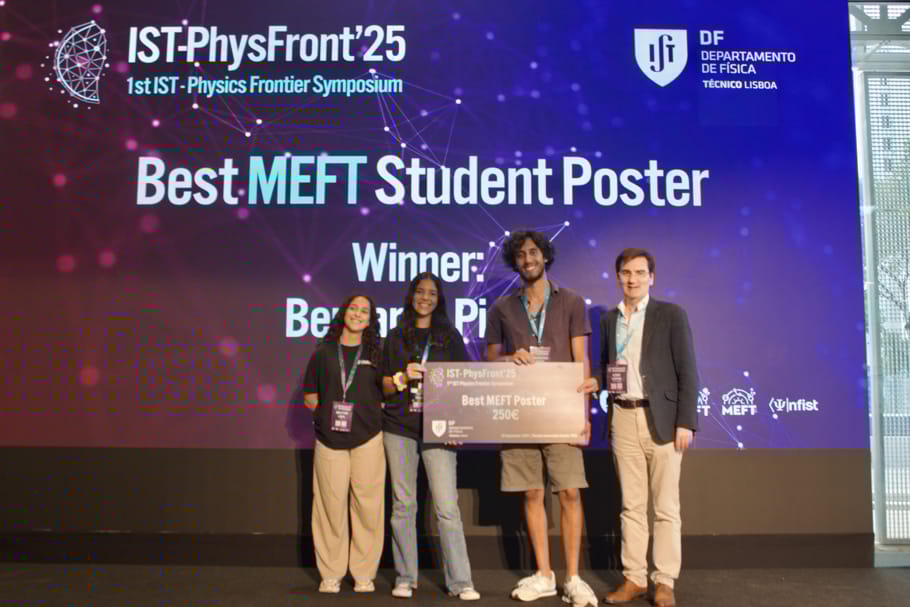
Beatriz Lima, Margarida Nóbrega, Bernardo Picão e Prof, Ilidio Lopes e a equipa do projeto FLASHGuard (representada por Gonçalo Ribeiro) recebeu o prémio na categoria de doutoramento com o poster FLASHGuard Project: Particle Physics Technology to Transform Cancer Treatment. 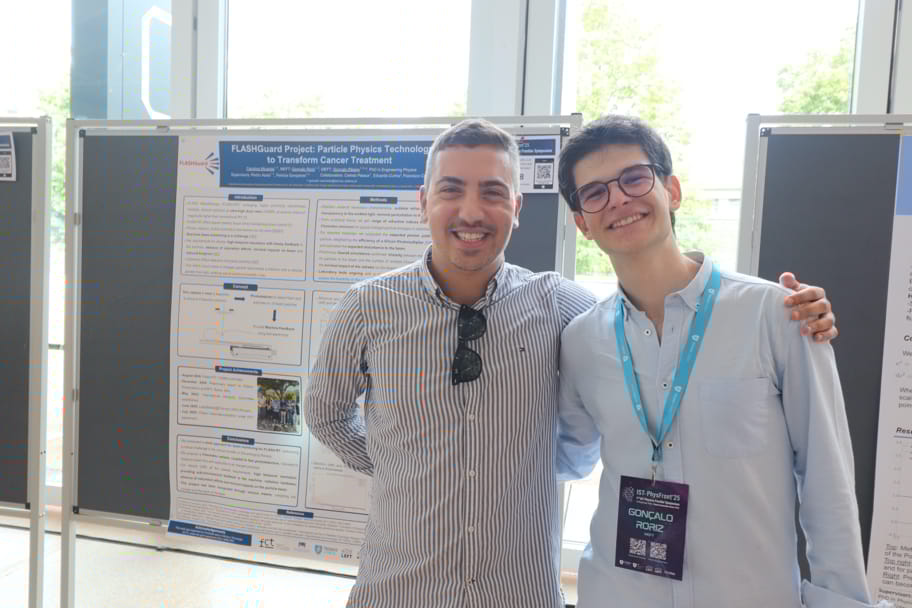
Gonçalo Ribeiro e Gonçalo Roriz (FlasGuard) A inovação também esteve em destaque com a entrega de outros galardões. O prémio para o melhor vídeo de PIC2 foi atribuído a Bruno Semião (MEFT), e o prémio de Inovação LEFT/MEFT distinguiu o projeto Noisr, selecionado entre finalistas que incluíam FlashGuard, Printable Labs e sensores triboelétricos com comunicação RFID.
 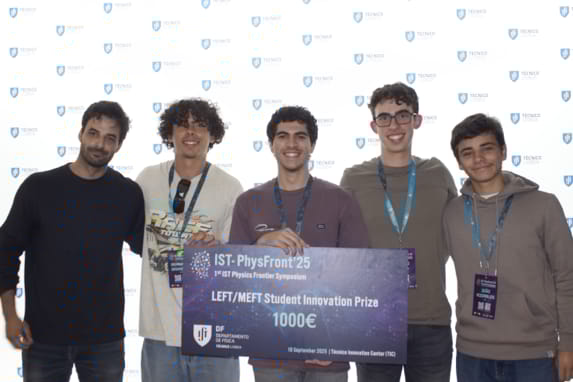
Bruno Semião Equipa Noisr A cerimónia final, marcada por um ambiente de celebração e orgulho, destacou o talento, a criatividade e o espírito colaborativo da comunidade do DF-IST. O IST-PhysFront’25 afirmou-se como um novo espaço de encontro entre ciência, tecnologia e imaginação, lançando as bases para futuras edições que continuarão a dar visibilidade à excelência e à vitalidade do DF no Técnico. Fotos do PhysFront’25 podem ser vistas na fotogaleria da organização ou na do IST. | |
| | Complementos de Matemática para FísicaDesde o início do ano letivo, decorre no Espaço +Física a iniciativa “Complementos de Matemática para Física”, criada por três estudantes da LEFT (da esquerda para a direita na foto em baixo: Filipe Santos, Tomás Gaspar e Gabriel Almeida) com o apoio/colaboração do DF. O projeto visa aprofundar a preparação em física/matemática dos alunos da LEFT e do MEFT, fortalecendo as suas bases para unidades curriculares de Física. 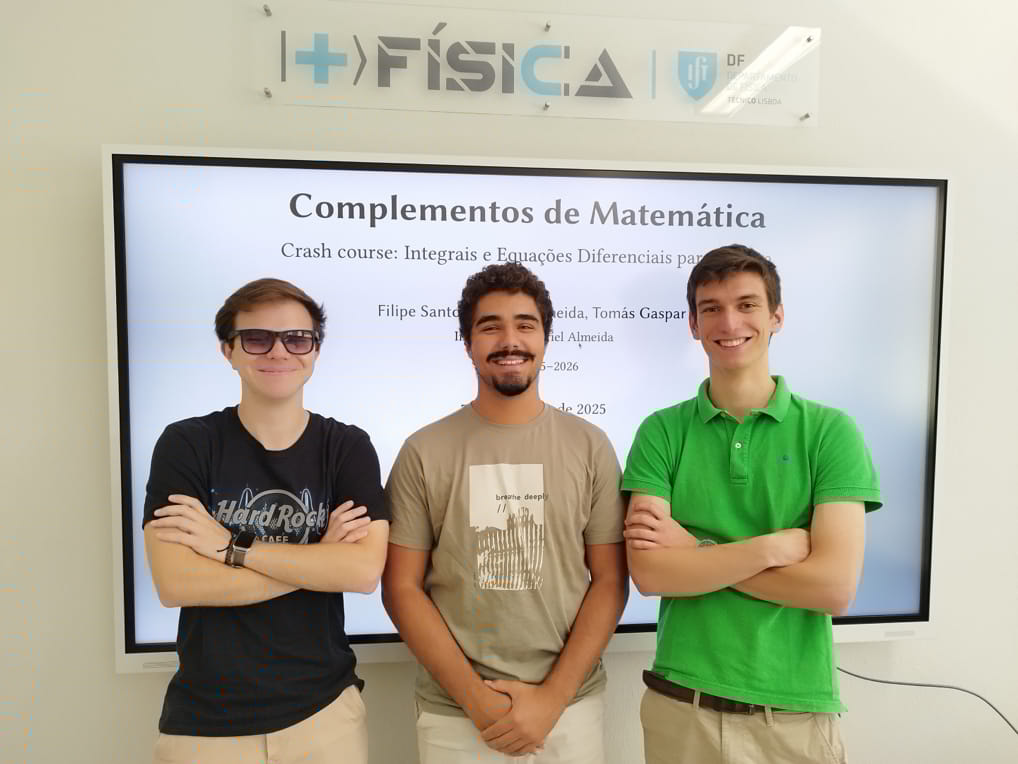
No primeiro período foi oferecido o minicurso "Crash Course em Integrais e Equações Diferenciais para a Física", especialmente dirigido a estudantes do 1.º ano e com a colaboração da Leonor Gonçalves (MEFT). A adesão foi expressiva, com cerca de 80 inscrições, confirmando o interesse e relevância dos temas. 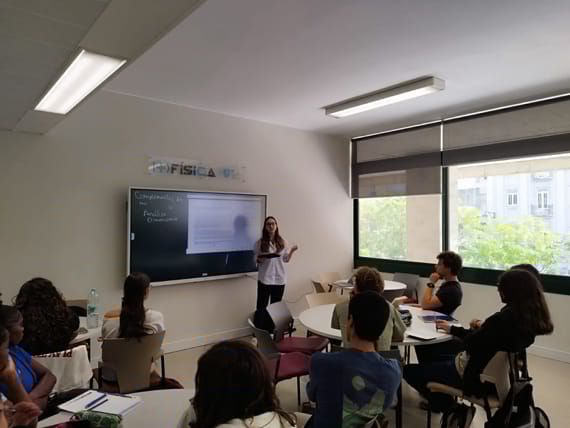 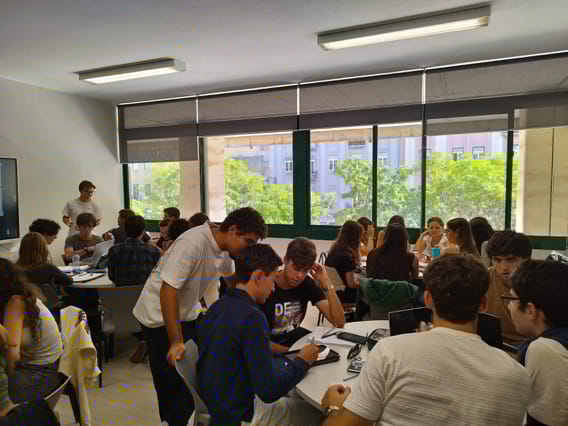
No próximo período será lançado o minicurso "Espaços de Hilbert e Tensores para a Física", destinado a estudantes do 2.º e 3.º ano. Dividido em dois módulos — Espaços de Hilbert e Tensores — o primeiro abordará ferramentas fundamentais da Mecânica Quântica, enquanto o segundo terá um foco mais prático em aplicações de Tensores à Física. No segundo semestre, está ainda previsto o minicurso Geometria, Grupos e Teoria de Lie para a Física, pensado para alunos a concluir o 3.º ano ou já no Mestrado. As inscrições estarão disponíveis em breve na página web do Espaço +Física. Este projeto ilustra de forma exemplar como as iniciativas dos alunos do nosso departamento podem contribuir para uma comunidade académica mais sólida, dinâmica e colaborativa. | |
| | Novos alunos LEFT2025No passado dia 01 de setembro, a coordenação LEFT/MEFT e o Departamento de Física deram as boas-vindas aos novos estudantes da LEFT 2025/2026. Tal como em anos anteriores, todas as vagas foram preenchidas, mantendo-se a nota mínima de ingresso entre as mais elevadas do país para cursos similares. A LEFT continua, assim, a afirmar-se como um curso de excelência do Técnico, reconhecido pela qualidade e pela exigência, que atrai alunos talentosos e fortemente motivados de todo o território nacional. 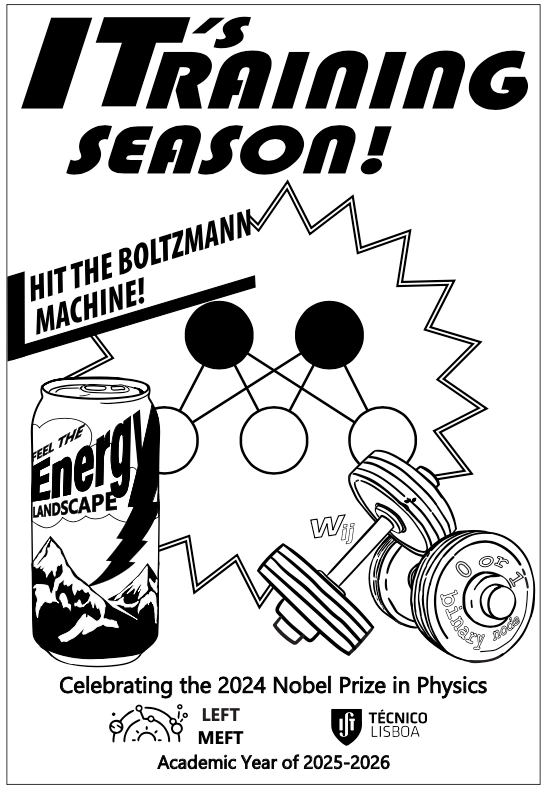
Como tem vindo a ser tradição nos últimos anos, a coordenação da LEFT/MEFT oferece aos novos alunos uma t-shirt alusiva ao tema do Prémio Nobel da Física do ano anterior. Em 2024, o mesmo foi atribuído a John J. Hopfield e Geoffrey Hinton “por descobertas e invenções fundamentais que possibilitam a aprendizagem automática com redes neuronais artificiais”. Este ano, o desenho da t-shirt (ver em cima) foi da autoria do Aluno Gonçalo Oliveira da LEFT. Desejamos a todos os novos estudantes o maior sucesso nesta nova etapa do seu percurso académico. | |
|
|
|
| |
Novo docente do DF Nuno Leonardo fez a licenciatura em Física no IST, o mestrado em Cambridge, e o doutoramento no Massachussets Institute of Technology (MIT) nos EUA. A sua investigação tem sido realizada nos aceleradores de partículas de mais alta energia, no Fermilab e no CERN. A sua tese de doutoramento, que resultou na primeira observação de oscilações partícula-antipartícula com mesões Bs, foi realizada com a experiência Collider Detector at Fermilab (CDF) no Tevatrão. 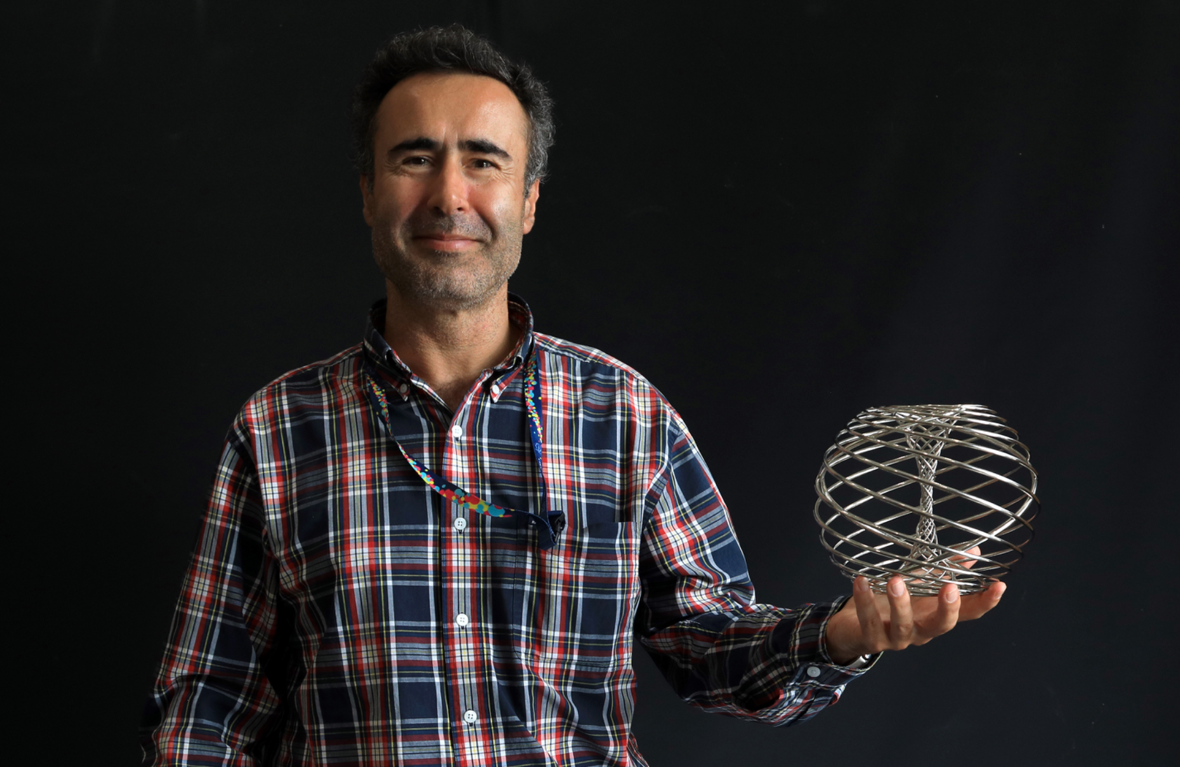
Foi fellow do CERN e investigador sénior em Purdue antes de se juntar ao Laboratório de Instrumentação e Física Experimental de Partículas (LIP) como investigador principal. O foco da sua investigação pósdoutoral tem sido no Large Hadron Collider (LHC), no CERN. Na experiência CMS, desempenhou funções de liderança na aquisição e análise de dados. Coordenou na experiência Compact Muon Solenoid (CMS) e coordena no LHC o grupo de trabalho de flavour physics. Coordena ainda a participação portuguesa em novas experiências do CERN, Scattering and Neutrino Detector at the LHC (SND@LHC) e Search for Hidden Particles (SHiP). Mantém amplos interesses de investigação em física de partículas, abrangendo sabores pesados, neutrinos, Higgs, plasma de quarks e gluões, e busca de novas partículas, para além do modelo padrão. | |
| |
Radiação de Hawking em Buracos Negros Acústicos Nos dias 15 e 18 de setembro, o DF recebeu o Professor Jeff Steinhauer, do Technion – Israel Institute of Technology, para ministrar o mini-curso “Hawking radiation in an acoustic Black Hole”. A iniciativa integrou o Programa de Visitantes do DF e contou com a presença de cerca de 60 estudantes LEFT/MEFT e doutoramento. 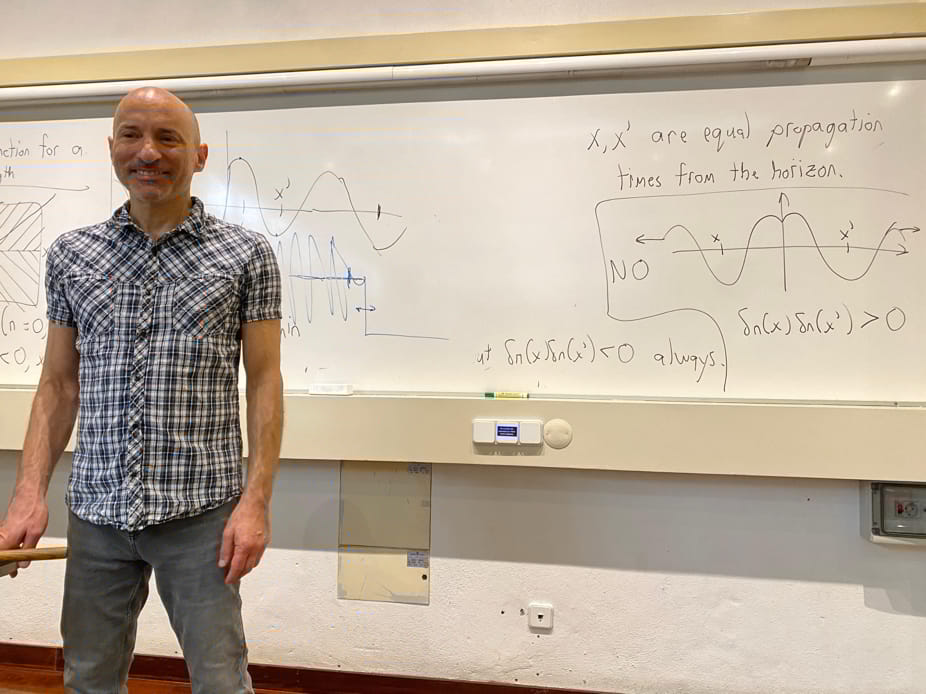
Ao longo das duas sessões, os participantes tiveram uma introdução intuitiva ao fenómeno da radiação de Hawking em buracos negros sónicos, uma das manifestações mais fascinantes da física moderna. Na primeira sessão, o Professor Steinhauer abordou os aspetos semiclássicos da radiação de Hawking e discutiu as observações experimentais obtidas através da função de correlação densidade-densidade, um dos principais indicadores do efeito em sistemas de condensados de Bose-Einstein. A segunda sessão teve um caráter prático e interativo: os estudantes utilizaram e adaptaram código em Python para simular a emissão térmica de radiação de Hawking, analisando as funções de correlação resultantes e comparando-as com dados experimentais reais. A atividade terminou com um breve exercício de reflexão escrita sobre a interpretação física dos resultados obtidos. Combinando conceitos teóricos, análise experimental e simulação computacional, este mini-curso proporcionou aos participantes uma experiência única de contacto direto com a investigação de fronteira na área da gravitação analógica, aproximando a física de buracos negros do laboratório e do mundo real. | |
| |
Náboj da Física no TICNo próximo dia 7 de Novembro irá decorrer no Técnico Innovation Center (TIC) o primeiro Náboj de Física em Portugal com o apoio do DF. 
À semelhança do Náboj da Matemática já realizado em Portugal, O Naboj da Física é uma competição internacional de física destinada a equipas de quatro ou cinco estudantes do ensino básico e secundário que representam as suas escolas. No período da manhã haverá uma competição com duração de 120 minutos, durante os quais as equipas tentam resolver o maior número possível de problemas propostos. No início da competição, cada equipa recebe oito problemas. Assim que a equipa resolve corretamente qualquer um dos problemas, recebe um novo. As soluções dos problemas são, geralmente, valores numéricos. A equipa que resolver o maior número de problemas corretamente dentro do tempo limite será a vencedora. No período da tarde os participantes do Náboj poderão assistir a uma palestra dada pelo Professor Vitor Cardoso, e ainda conhecer a LEFT nas palavras do seu Coordenador, o Professor Jorge Vieira. O evento encerra com a entrega de prémios que serão livros da IST Press escritos por docentes do DF. Como não podia deixar de ser, o NFIST estará presente para animar os participantes com algumas demonstrações do Circo da Física. | |
| |
Lançamento do livro "Assim nasce uma ideia”No passado dia 16 de outubro foi apresentado no anfiteatro Abreu Faro o livro Assim nasce uma ideia, publicado pela Gradiva. A obra, que pretende ser uma reflexão sobre o momento em que surge a criatividade na ciência, nasceu da colaboração entre o Professor Vítor Cardoso do DF e diretor do Center of Gravity do Instituto Niels Bohr, e a artista e designer Ana Carvalho, que durante dez anos recolheram relatos de cientistas, estudantes e prémios Nobel sobre a origem das ideias em física — incluindo contributos de membros do Técnico. 
Créditos da imagem: IST Na sessão de lançamento, que juntou também o historiador Henrique Leitão e a jornalista do Público Teresa Firmino, os autores evocaram o percurso de um projeto que começou sem plano definido, apenas com a curiosidade de perceber como nasce uma descoberta. Ana Carvalho sublinhou a diferença entre o olhar artístico e o científico sobre a criação: “Os artistas aprendem a questionar o seu processo; os cientistas raramente param para pensar no instante em que algo novo se forma.” Vítor Cardoso recordou um episódio que o marcou: uma reflexão sobre a bomba atómica que o levou a perceber paralelismos entre reações nucleares e buracos negros. “Às vezes as ideias duram pouco, mas deixam um rasto. O essencial é o impulso de compreender”, afirmou. Para Teresa Firmino, o livro dá a ver “o que normalmente fica fora dos artigos e das conferências — as dúvidas, o entusiasmo, o erro e a persistência que fazem parte de qualquer descoberta”. Já Henrique Leitão destacou a autenticidade das respostas reunidas: “Não se trata de doutrinar, mas de captar a pureza do momento criativo. A vida de um cientista é, no fundo, uma persistência em compreender o que ainda ninguém compreende.” Com mais de uma centena de testemunhos, Assim nasce uma ideia propõe-se mostrar o que move a ciência: a curiosidade, a dúvida e o prazer de perceber, mesmo quando o avanço é pequeno, mas profundamente humano. | |
| |
O NFIST tem nova Direção!Levar a Física à comunidade - é esta a missão principal do Núcleo de Física do Instituto Superior Técnico (NFIST), desde a sua criação, há 30 anos. Neste ano letivo, será presidido por 5 estudantes do 3.º ano da LEFT: Beatriz Lima (Tesoureira), Carlota Pataca (Vice-presidente), Madalena Fontes (Secretária), Margarida Nóbrega (Presidente) e Rita Paraíba (Vice-presidente). 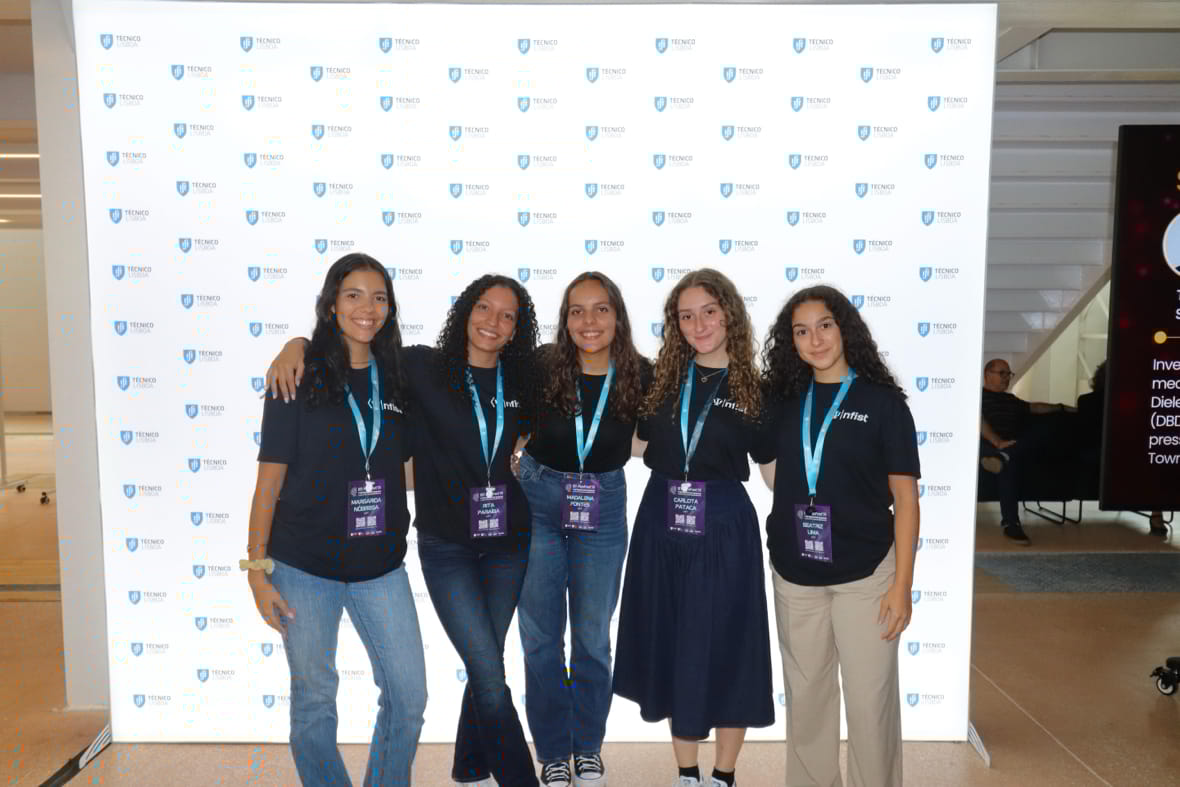
Da esquerda para a direita na foto: Margarida Nóbrega, Rita Paraíba, Madalena Fontes, Carlota Pataca e Beatriz Lima. Como sempre, a disseminação da Ciência - da Física, particularmente - é um dos focos deste mandato. Tal será alcançado através dos (inovados) eventos que os estudantes de Física do IST acompanham há décadas, como a Semana da Física e as Jornadas da Engenharia Física. Também serão impulsionados eventos mais recentes, que visam o mesmo fim, como a Escola de Verão de Astronomia e as Estrelas Sobre o Atlântico. Este último foi desenvolvido durante o ano letivo de 23/24 e levou a diversão das experiências do Circo da Física e a magia dos telescópios e planetário da Astro aos Açores. Este ano, o projeto vai até à Madeira. Há, ainda, uma vontade de servir os estudantes da LEFT e MEFT mais além. A realizar-se a 12 de novembro, o "After (I) LEFT" será uma nova iniciativa que irá mostrar que portas se abriram aos Alumni do curso após a conclusão do mesmo - e por quais eles entraram. Também emergente é a preocupação em relação à saúde mental dos estudantes, visando-se criar vários programas de apoio, quer ao percurso escolar, quer pessoal. Para além disto, a Pulsar vai continuar na sua debanda de fornecer à comunidade estudantil ferramentas úteis para o seu desempenho académico, no âmbito da Pulsar Ensina. A paixão pela Física, o seu ensino e a sensação de comunidade são as bases pelas quais o trabalho deste ano se desenvolverá. Será, certamente, inesquecível. | |
| |
10 Anos a detetar Ondas GravitacionaisNo dia 14 de setembro, assinalou-se o 10.º aniversário da primeira deteção de ondas gravitacionais nos detetores LIGO. Esta descoberta revolucionária abriu uma nova janela para o Universo, permitindo-nos observar buracos negros e estrelas de neutrões de formas nunca antes possíveis. Desde então, a ciência das ondas gravitacionais floresceu, contando com a contribuição essencial de vários investigadores e estudantes do Centro de Astrofísica e Gravitação (CENTRA), um grupo de investigação integrado no Departamento de Física. Para celebrar este marco, a Sociedade Portuguesa de Relatividade e Gravitação (SPRG), em colaboração com a Ciência Viva, organizou uma série de eventos em todo o país, realizados nos centros Ciência Viva de Lisboa, Aveiro e Porto. Em Lisboa, no Pavilhão do Conhecimento, atuais e antigos membros do CENTRA, com o valioso apoio dos estudantes de física do Núcleo de Física do Instituto Superior Técnico (NFIST), apresentaram demonstrações interativas ao longo de todo o dia. Os visitantes tiveram a oportunidade de explorar o que são as ondas gravitacionais, como são detetadas e quais os desafios futuros deste campo fascinante. 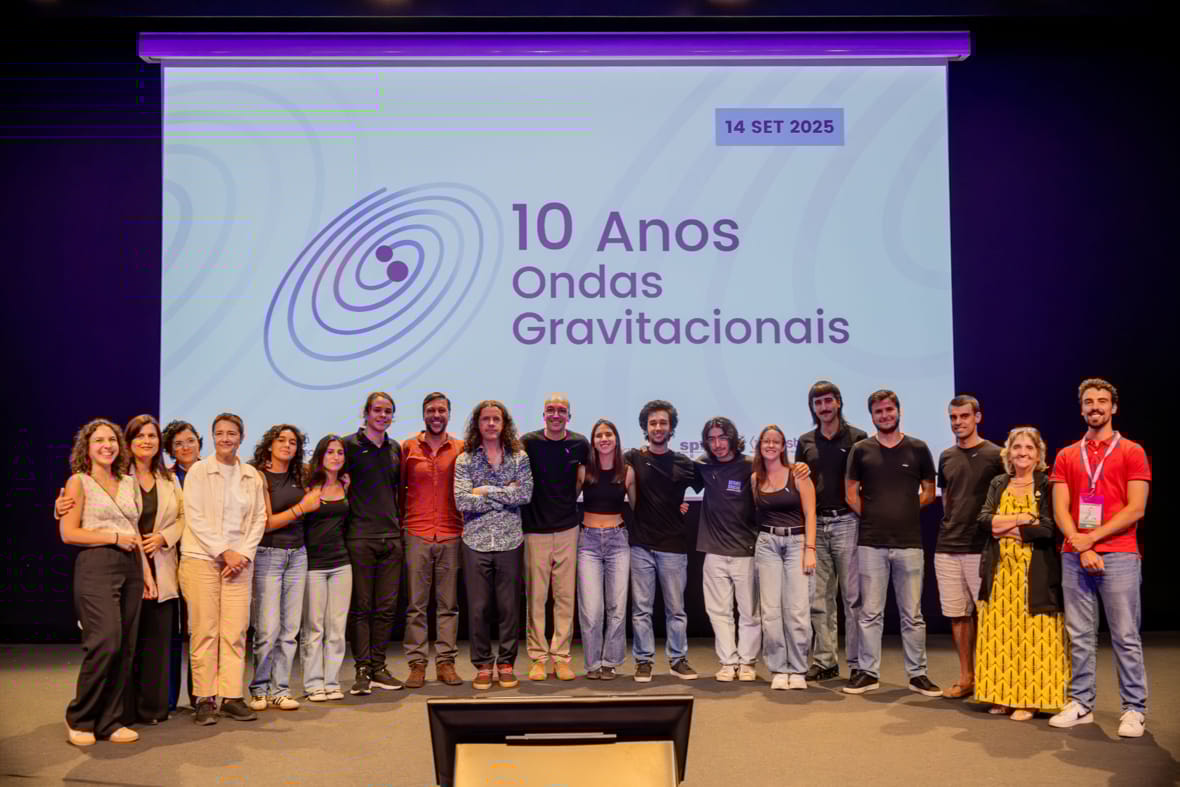 Créditos da foto: Ciência Viva Créditos da foto: Ciência Viva
Durante a tarde, o Prof. Vítor Cardoso proferiu uma cativante palestra pública, introduzida pelo Prof. Jorge Rocha, Presidente da SPRG. A palestra encontra-se disponível online. O evento foi um enorme sucesso, com sala cheia na palestra e uma participação entusiástica ao longo do dia. Que venham mais dez anos de descobertas revolucionárias na ciência das ondas gravitacionais!
| |
| |
Top 2% do ranking the Standford em 2024A Universidade de Stanford (Estados Unidos da América) e o grupo editorial Elsevier publicaram a sua lista anual com os nomes dos 200 mil cientistas mais citados a nível mundial, representando o top 2%, o “ranking de Stanford”. A lista de mais citados em 2024 conta com os seguintes investigadores pertencentes a unidades de investigação associadas ao DF: Parabéns a todos! | |
| |
Próximos colóquios do DF- 5 Novembro (16h, PA1): "Towards AntiMatter-based Nuclear Reactor Tomography and Beyond”, Anatael Cabrera (CNRS / Université Paris-Saclay — IJCLab (Orsay) / LNCA (Chooz) )
- 27 Novembro (16h, Anfiteatro Abreu Faro): "Exploring the dark Universe with gravitational waves: new opportunities from the precision frontier”, Diego Blas (Institut de Fisica d'Altes Energies (IFAE), The Barcelona Institute of Science and Technology (BIST)).
| |
| |
Calendário do DF (Próximos Eventos)- Sessão Plenária do Conselho do DF (29 de outubro, 11.30, anfiteatro PA1).
- Almoço convívio (29 de outubro, 13.00, sala P12) para todos os professores, investigadores e funcionários não docentes do DF.
| | | |
|
|
|
| | IST-PhysFront’25The 1st IST-Physics Frontier Symposium (IST-PhysFront'25) took place on September 10, 2025, at the Técnico Innovation Center (TIC), bringing together students, researchers, and faculty for a day dedicated entirely to cutting-edge research in physics. Organized by the Physics Department (DF), the LEFT/MEFT coordination, and the NFIST, the event marked the beginning of what is expected to be an annual tradition that aims to celebrate physics and engineering in the DF and foster engagement between different fields and generations. This first edition had as its central theme "Machine Learning in Physics," reflecting the growing impact of artificial intelligence on the way physicists simulate, measure, and understand the natural world.
Professor Rogério Colaço (President of IST) at the opening of PhysFront’25 The morning's thematic session featured a panel addressing the application of artificial intelligence in multiple domains of physics. Frederico Fiúza opened the program with "The AI Physicist: Learning Equations from Data," followed by Susana Freitas, who presented "Decoding Touch: Machine Learning and Spintronic Sensors Beneath Magnetic Skins." Giuseppe De Tomasi explored the role of machine learning in nonequilibrium quantum systems, Vasco Guerra addressed the importance of physical coherence in machine learning models, Rúben Conceição highlighted the use of AI in astroparticle experiments, and Marco Piccardo concluded with "Optics that Learn," on adaptive optics and intelligent systems. In the afternoon, the Research Highlight Session showcased some of the broader research themes conducted at DF-IST. Andreas Trautner, Liliana Apolinário, Marta Fajardo, and Richard Brito presented papers ranging from fundamental symmetries in quantum field theory to hadronic collisions, from the interaction of intense lasers with matter to gravitational waves and relativity as a tool for probing new regimes of fundamental physics. One of the most inspiring moments was the Outstanding Student Talks, where four young researchers presented their projects. Duarte Lopes (LEFT) spoke about particle injection mechanisms in astrophysical collisions, Gonçalo Roriz (LEFT) presented the development of ultrafast electronics for FLASH radiotherapy, Mariana Abreu (MEFT) discussed phase transitions in quasi-periodic systems, and Gonçalo Martins (MEFT) addressed the cosmological implications of differences between supernova host galaxies and the tension in the Hubble constant.
Mariana Abreu (MEFT) and Gonçalo Roriz (LEFT)
Gonçalo Martins (MEFT) and Duarte Lopes (LEFT) Throughout the day, poster sessions filled the TIC lobby with enthusiasm and an exchange of ideas among students from all three cycles—LEFT, MEFT, and PhD. The papers presented covered topics as diverse as particle physics, astrophysics, quantum optics, sensors, and advanced materials. The audience voted for their favorite posters, and the awards were announced at the end of the day:
Inês Alvito and Carolina Antunes won in the LEFT category, with their posters Sensitivity of Shower Footprint
Variables to High- and Low-Energy
Hadronic Interaction Models and Wireless Triboelectric Wearable Sensors for Self-Powered Biomechanical Monitoring
Bernardo Picão was distinguished in the MEFT category with the poster Got to bind them all! Computing tetraquark potentials on the lattice,
Beatriz Lima, Margarida Nóbrega, Bernardo Picão and Prof, Ilidio Lopes and the FLASHGuard project team (represented by Gonçalo Ribeiro) received the award in the doctorate category with the poster FLASHGuard Project: Particle Physics Technology to Transform Cancer Treatment.
Gonçalo Ribeiro and Gonçalo Roriz (FlasGuard) Innovation was also highlighted with other awards. The award for best PIC2 video went to Bruno Semião (MEFT), and the LEFT/MEFT Innovation Award went to the Noisr project, selected from among finalists that included FlashGuard, Printable Labs, and triboelectric sensors with RFID communication.
Bruno Semião Equipa Noisr The final ceremony, marked by an atmosphere of celebration and pride, highlighted the talent, creativity, and collaborative spirit of the DF-IST community. IST-PhysFront'25 established itself as a new meeting place for science, technology, and imagination, laying the foundation for future editions that will continue to highlight the excellence and vitality of the DF at Técnico. Photos from PhysFront'25 can be viewed in the organization's photo gallery or in IST's. | |
| | Maths Complements for PhysicsSince the beginning of the school year, the "Mathematics Supplements for Physics" initiative has been taking place at Espaço +Física. This initiative was created by three LEFT students (from left to right in the photo below: Filipe Santos, Tomás Gaspar, and Gabriel Almeida) with the support and collaboration of the DF. The project aims to deepen the physics/mathematics preparation of LEFT and MEFT students, strengthening their foundation for Physics curricular units.
During the first semester, the mini-course "Crash Course in Integrals and Differential Equations for Physics" was offered, specifically for first-year students, in collaboration with Leonor Gonçalves (MEFT). Participation was impressive, with approximately 80 registrations, confirming the interest and relevance of the topics.
The minicourse "Hilbert Spaces and Tensors for Physics" will be launched next semester, aimed at second- and third-year students. Divided into two modules—Hilbert Spaces and Tensors—the first will cover fundamental tools of Quantum Mechanics, while the second will have a more practical focus on tensor applications in Physics. Also planned for the second semester is the minicourse "Geometry, Groups, and Lie Theory for Physics," designed for students completing their third year or already in their Master's program. Registration will soon be available on the Espaço +Física website. | |
| | New LEFT2025 StudentsOn September 1st, the LEFT/MEFT coordination team and the Physics Department welcomed new LEFT 2025/2026 students. As in previous years, all spots were filled, maintaining the minimum admission score among the highest in the country for similar programs. LEFT thus continues to establish itself as a top-notch Técnico program, recognized for its quality and high standards, attracting talented and highly motivated students from across the country.
As has become tradition in recent years, the LEFT/MEFT coordination team offers new students a t-shirt commemorating the previous year's Nobel Prize in Physics. In 2024, the prize was awarded to John J. Hopfield and Geoffrey Hinton "for fundamental discoveries and inventions enabling machine learning with artificial neural networks”. This year, the t-shirt design (see above) was by LEFT student Gonçalo Oliveira. We wish all new students the greatest success in this new stage of their academic journey. | |
| |
New DF professor Nuno Leonardo earned his undergraduate degree in Physics from IST, his master's degree from Cambridge, and his doctorate from MIT. His research has been conducted at the highest-energy particle accelerators at Fermilab and CERN. His doctoral thesis, which resulted in the first observation of particle-antiparticle oscillations with Bs mesons, was conducted with the CDF experiment at the Tevatron.
He was a CERN fellow and a senior researcher at Purdue before joining LIP as a principal investigator. His postdoctoral research has focused on the Large Hadron Collider (LHC) at CERN. At the CMS experiment, he has occupied leading positions in data acquisition and analysis. He coordinated the flavor physics working group at CMS and currently coordinates it at the LHC. He also coordinates Portuguese participation in new CERN experiments, SND@LHC, and SHiP. He maintains broad research interests in particle physics, including heavy flavors, neutrinos, the Higgs, quark-gluon plasmas, and the search for new particles beyond the Standard Model.
| |
| |
Radiação de Hawking em Buracos Negros Acústicos On September 15th and 18th, the DF welcomed Professor Jeff Steinhauer of the Technion – Israel Institute of Technology, to teach the short course "Hawking Radiation in an Acoustic Black Hole”. The initiative was part of the DF Visitors Program and was attended by approximately 60 LEFT/MEFT and doctoral students.
Over the course of two sessions, participants received an intuitive introduction to the phenomenon of Hawking radiation in sonic black holes, one of the most fascinating manifestations of modern physics. In the first session, Professor Steinhauer addressed the semiclassical aspects of Hawking radiation and discussed experimental observations obtained using the density-density correlation function, one of the key indicators of the effect in Bose-Einstein condensate systems. The second session was practical and interactive: students used and adapted Python code to simulate the thermal emission of Hawking radiation, analyzing the resulting correlation functions and comparing them with real experimental data. The activity concluded with a brief written reflection exercise on the physical interpretation of the results obtained. Combining theoretical concepts, experimental analysis, and computational simulation, this short course provided participants with a unique experience of direct contact with cutting-edge research in the field of analog gravitation, bringing black hole physics closer to the laboratory and the real world. | |
| |
Physics Náboj at TICOn November 7th, the first Physics Náboj in Portugal will take place at the Técnico Innovation Center (TIC), with the support of the DF.
Like the Mathematics Náboj already held in Portugal, the Physics Náboj is an international physics competition for teams of four or five elementary and high school students representing their schools. In the morning, there will be a 120-minute competition, during which teams attempt to solve as many problems as possible. At the beginning of the competition, each team receives eight problems. After a team correctly solves any of the problems, they receive a new one. The solutions to the problems are usually numerical values. The team that solves the most problems correctly within the time limit is the winner. In the afternoon, Náboj participants will be able to attend a lecture given by Professor Vitor Cardoso and learn about LEFT through the words of its Coordinator, Professor Jorge Vieira. The event concludes with the presentation of prizes, which will be IST Press books written by professors from the DF. As expected, NFIST will be there to entertain participants with some demonstrations from the Physics Circus. | |
| |
Launch of the book "Assim nasce uma ideia”
On October 16th, the book Assim Nasce Uma Ideia, published by Gradiva, was presented at the Abreu Faro Amphitheater. The work, intended as a reflection on the moment when creativity emerges in science, was born from a collaboration between Professor Vítor Cardoso of the DF and director of the Center of Gravity at the Niels Bohr Institute, and artist and designer Ana Carvalho. For ten years, they collected accounts from scientists, students, and Nobel laureates about the origins of ideas in physics—including contributions from members of Técnico. Image credits: IST
At the launch session, which also featured historian Henrique Leitão and Público journalist Teresa Firmino, the authors discussed the trajectory of a project that began without a defined plan, simply out of curiosity to understand how a discovery is born. Ana Carvalho emphasized the difference between the artistic and scientific perspectives on creation: "Artists learn to question their process; scientists rarely stop to think about the moment something new is formed." Vítor Cardoso recalled an episode that had an impact on him: a reflection on the atomic bomb that led him to perceive parallels between nuclear reactions and black holes. "Sometimes ideas don't last long, but they leave a trail. The essential thing is the drive to understand”, he said. For Teresa Firmino, the book reveals "what is normally left out of articles and conferences—the doubts, enthusiasm, mistakes, and persistence that are part of any discovery”. Henrique Leitão, meanwhile, emphasized the authenticity of the collected responses: "It's not about indoctrinating, but about capturing the purity of the creative moment. The life of a scientist is, at its core, a persistence in understanding what no one understands yet." With over one hundred testimonies, Assim nasce uma ideia, aims to show what drives science: curiosity, doubt, and the pleasure of perceiving, even when the progress is small but deeply human. | |
| |
NFIST has a new direction!Bringing physics to the community — this has been the core mission of the Physics Center of the Instituto Superior Técnico (NFIST) since its inception 30 years ago. This academic year, it will be led by five third-year LEFT students: Beatriz Lima (Treasurer), Carlota Pataca (Vice-President), Madalena Fontes (Secretary), Margarida Nóbrega (President), and Rita Paraíba (Vice-President).
From left to right: Margarida Nóbrega, Rita Paraíba, Madalena Fontes, Carlota Pataca e Beatriz Lima. As always, the dissemination of science, and physics in particular, is a key focus of this mandate. This will be achieved through innovative events that IST physics students have been following for decades, such as Physics Week and the Physics Engineering Conferences. More recent events with the same goal will also be promoted, such as the Astronomy Summer School and Stars Over the Atlantic. The latter was developed during the 23/24 academic year and brought the fun of the Physics Circus experiences and the magic of Astro's telescopes and planetarium to the Azores. This year, the project will extend to Madeira. There is also a desire to serve LEFT and MEFT students beyond. Taking place on November 12th, After (I) LEFT will be a new initiative that will showcase the doors that opened to alumni after completing the course, and which ones they entered. Also emerging is the concern regarding students' mental health, with the aim of creating various support programs, both for their academic and personal development. Furthermore, Pulsar will continue its commitment to providing the student community with useful tools for their academic performance, within the scope of Pulsar Ensina. The passion for Physics, its teaching, and the sense of community are the foundations on which this year's work will unfold. It will certainly be unforgettable. | |
| |
10 Years of Gravitational Wave detectionsOn September 14th, we marked the 10th anniversary of the first detection of gravitational waves observed at the LIGO detectors. This groundbreaking discovery opened a new window onto the Universe, allowing us to observe black holes and neutron stars in ways never before possible. Since then, gravitational-wave science has flourished, with several researchers and students from the Center for Astrophysics and Gravitation (CENTRA), a research group within the Physics Department, making key contributions to the field. To celebrate this milestone, the Portuguese Society for Relativity and Gravitation (SPRG), in collaboration with Ciência Viva, organised a series of events across the country, hosted in the Ciência Viva centres of Lisbon, Aveiro, and Porto. In Lisbon, at the Pavilhão do Conhecimento, current and former members of CENTRA, with the precious support of physics students from the Núcleo de Física do Instituto Superior Técnico (NFIST), presented hands-on demonstrations throughout the day. Visitors had the opportunity to explore what gravitational waves are, how they are detected, and what lies ahead for this exciting field. Picture Credits: Ciência Viva In the afternoon, Prof. Vítor Cardoso delivered a captivating public lecture, introduced by Prof. Jorge Rocha, President of SPRG. The lecture is freely available online. The event was a resounding success, with a full-house audience for the lecture and enthusiastic participation throughout the day. Here’s to the next decade of groundbreaking discoveries in gravitational-wave science! | |
| |
Top 2% of the Standford ranking in 2024Stanford University (United States of America) and the Elsevier publishing group have published their annual list of the 200,000 most cited scientists worldwide, representing the top 2%, the "Stanford ranking”. The 2024 most cited list includes the following researchers from research units associated with the DF: - Center for Astrophysics and Gravitation (CENTRA): Javier Rubio; José Sande Lemos; Masato Minamitsuji; Richard Brito; Ryuichi Fujita; Vitor Cardoso; Kyriakos Destounis.
- Center for Physics and Engineering of Advanced Materials (CeFEMA): (CeFEMA): César Sequeira; Diogo Santos; Pedro Bicudo; Rui Vilar.
- Centro de Física Teórica das Partículas (CFTP): Gustavo C. Branco; Luís Lavoura;
- Institute of Systems and Computer Engineering: Microsystems and Nanotechnologies (INESC MN): Marco Piccardo.
- Institute of Plasmas and Nuclear Fusion (IPFN): José T. Mendonça; Luís Lemos Alves; Luís Oliveira e Silva; Mikhail Benilov; Vasco Guerra.
Congratulations to all of them! | |
| |
Upcoming DF Colloquia- November 5 (4 p.m., PA1): "Towards AntiMatter-based Nuclear Reactor Tomography and Beyond," by Anatael Cabrera (CNRS / Université Paris-Saclay — IJCLab (Orsay) / LNCA (Chooz)
- November 27 (4 p.m., Abreu Faro Amphitheater): "Exploring the dark Universe with gravitational waves: new opportunities from the precision frontier," by Diego Blas (Institut de Fisica d'Altes Energies (IFAE), The Barcelona Institute of Science and Technology (BIST)).
| |
| |
DF Calendar (Upcoming Events)- DF Council Plenary session (October 29, 11:30 am, PA1 amphitheatre)
- Convivial lunch (October 29, 13:00, room P12) for all DF professors, researchers and non-teaching staff.
| | | |
|
|
|
|