| | Boletim de Notícias do DF #13(English version here) | |
|
|
|
| |
Equipa ISóTopos na competição PLANCKS 2026Os cursos de Engenharia Física Tecnológica do Técnico estiveram representados no PLANCKS 2026 pela equipa ISóTopos, constituída por João Goulão, Tomás da Costa, José Miguel Xavier e Filipe Miguel Rodrigues, alunos da LEFT/MEFT, cuja participação contou com o apoio do Departamento de Física e a organização da Associação Portuguesa de Estudantes de Física (PHYSIS). A competição internacional de Física, dirigida a estudantes de licenciatura e mestrado, decorreu entre 21 e 25 de maio, em Eindhoven, nos Países Baixos, e reuniu participantes de vários países num programa que incluiu a prova, palestras convidadas, visitas a empresas e momentos de convívio. 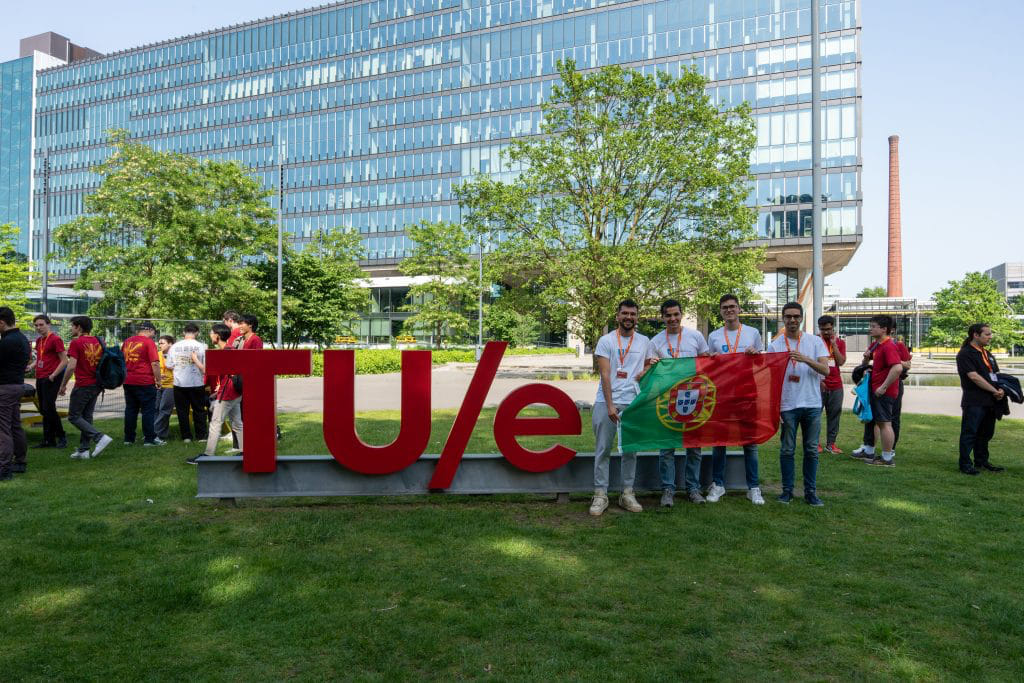
Segundo os estudantes, participar no PLANCKS 2026 foi “uma experiência inesquecível”, marcada pelo contacto com pessoas de diferentes culturas unidas pelo interesse comum pela Física. A equipa destacou, em particular, as palestras sobre fotónica e a sua importância na indústria atual, uma área com forte presença na região de Eindhoven, bem como a visita à Universidade de Twente, onde teve oportunidade de contactar com representantes de empresas ligadas a este setor. 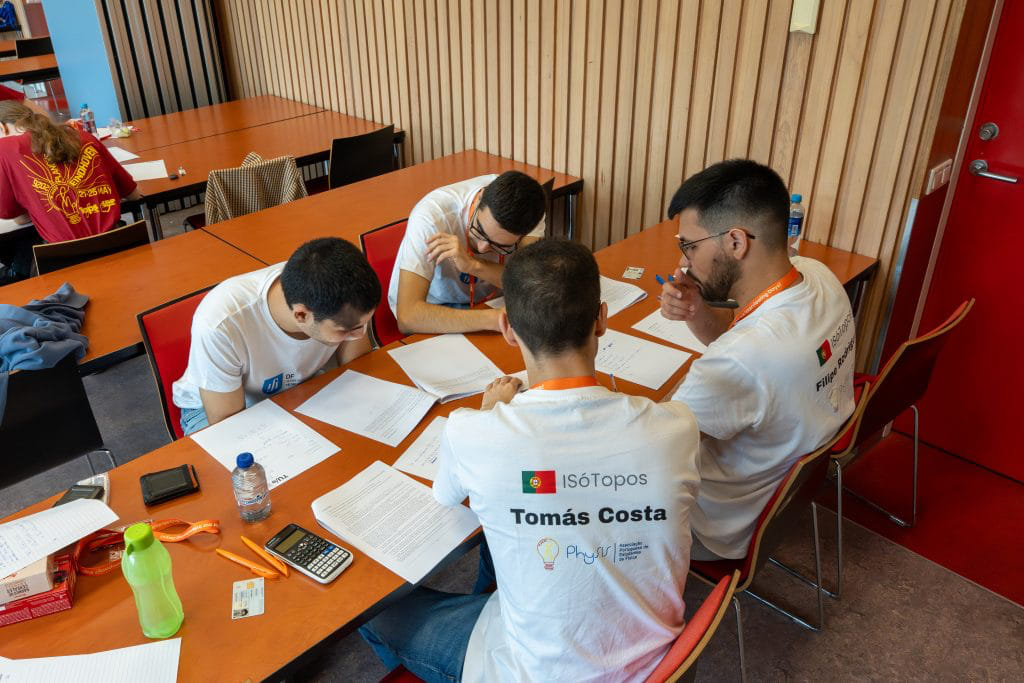
A prova, com a duração de quatro horas, foi considerada desafiante e estimulante. Os estudantes sublinharam o espírito de cooperação ao longo da resolução dos problemas, embora tenham referido que a prova teve uma forte componente de ótica e menor incidência em áreas como o eletromagnetismo ou a física estatística. Apesar de os resultados terem ficado aquém das expectativas (39º lugar em 54 equipas), a equipa considera que esta primeira participação foi uma experiência muito positiva e uma aprendizagem importante para futuras edições. Como resumem no seu testemunho, “o PLANCKS é muito mais do que um exame”, proporcionando uma oportunidade única de aprendizagem, partilha e convívio entre estudantes de Física de todo o mundo. | | | |
| | FLASHGuard faz história no MIT e reforça presença internacional
O projeto FLASHGuard, desenvolvido pelo LIP, através do grupo Particles4Health, em parceria com a RTBeamTech e o Instituto Superior Técnico, tornou-se a primeira equipa portuguesa e o primeiro projeto estrangeiro a alcançar a final da prestigiada MIT $100K Entrepreneurship Competition, uma das mais importantes competições universitárias de empreendedorismo do mundo.
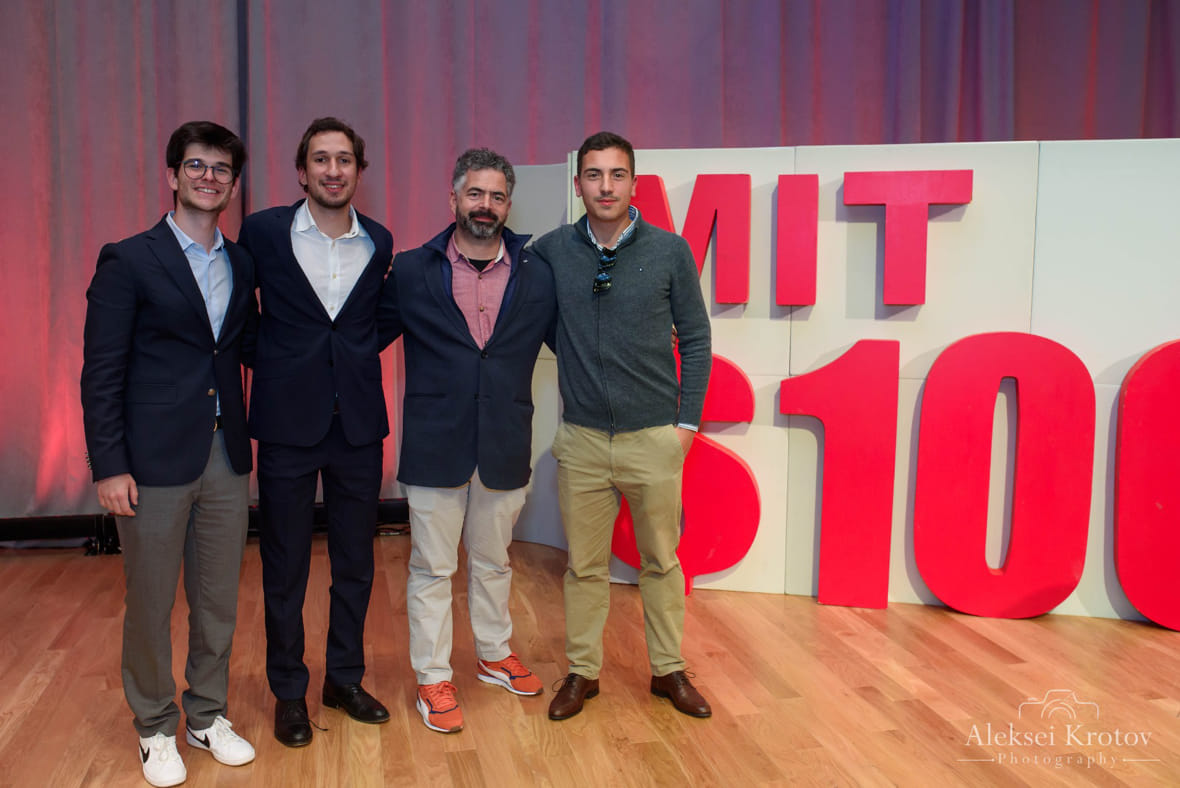
Da esquerda para a direita na foto: Gonçalo Roriz, Manuel Ratola, Prof. Pedro Assis e Gonçalo Ribeiro
Após vencer o MIT $100K Portugal, a equipa representou o país em Boston, apresentando a sua tecnologia perante investidores, empreendedores e líderes globais de inovação. A crescente projeção internacional foi reforçada por uma reunião em Bruxelas com Momchil Sabev, Diretor da EISMEA (European Innovation Council and SMEs Executive Agency), para apresentar os avanços e o potencial de impacto do FLASHGuard, bem como pela participação na EIC Summit 2025.
Nos últimos meses, o projeto conquistou vários reconhecimentos, incluindo o CaixaImpulse Health Innovation Stage 1 Grant, o Lab2Market@Técnico 2025, o LISPOLIS Ignite 2025 e a Europe’s Youth Start-Up Competition 2025. Este percurso evidencia a capacidade de Portugal para transformar investigação científica de excelência em inovação com impacto global na área da saúde. | | | |
| |
Novos Laboratórios de Física do Técnico:
uma nova etapa no ensino experimental
Desde a inauguração, em janeiro de 2026, dos
novos Laboratórios de Física do Instituto Superior Técnico, o Departamento de
Física passou a dispor de uma infraestrutura de referência para o ensino
experimental da Física. Estes novos espaços foram concebidos para apoiar o
ensino curricular, criando melhores condições para uma aprendizagem ativa,
rigorosa e próxima da prática científica e tecnológica contemporânea.
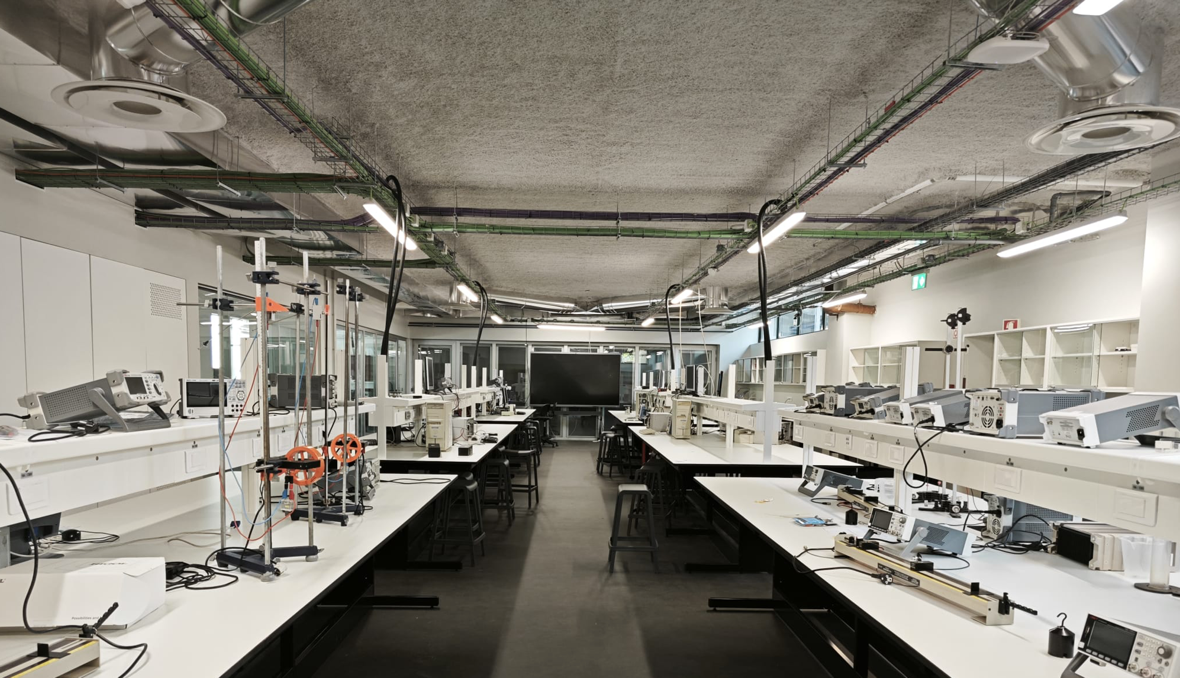
A concretização desta infraestrutura resulta
de um esforço continuado ao longo de vários anos, envolvendo sucessivas
presidências do Departamento, muitos docentes e técnicos, bem como o apoio
institucional do Técnico. A sua plena exploração exige agora um modelo de
governação claro e sustentável, capaz de articular visão pedagógica,
funcionamento técnico e desenvolvimento futuro.
Nesse contexto, foram criadas duas direções
complementares. O Professor Marco Piccardo assume a função de Diretor
Pedagógico dos Laboratórios de Física do IST, com responsabilidade pela
estratégia pedagógica do ensino experimental, pela qualidade das atividades
laboratoriais e pela articulação curricular das unidades de ensino que utilizam
estes espaços. A Professora Susana Freitas assume a função de Diretora
Operacional dos Laboratórios de Física do IST, responsável pelo funcionamento
quotidiano, manutenção, segurança, gestão técnica e desenvolvimento da
infraestrutura.
Em estreita colaboração entre si, com a
Presidência do Departamento e com os colegas, técnicos e estudantes, estas Direções procurarão assegurar que os novos laboratórios se tornam um
ecossistema dinâmico de ensino, experimentação e inovação, ao serviço dos
estudantes e de toda a comunidade académica do Técnico.
| |
|
|
|
| |
Universo - Infinitamente grande ou infinitamente pequeno?
Na sessão de abril da iniciativa “Explica-me como se tivesse 5 anos”, Pedro Abreu, docente do DF e investigador no LIP, levou os participantes numa viagem entre o infinitamente grande e o infinitamente pequeno, a partir de uma pergunta aparentemente simples: de que são feitas as coisas? Partindo do Sol, das estrelas e das galáxias, a sessão mostrou como a ciência foi alargando a nossa visão do Universo, com a ajuda de instrumentos como os telescópios. Depois, numa inversão de escala, o investigador passou para o mundo dos microscópios, dos átomos e das partículas fundamentais, explicando como aceleradores como o Large Hadron Collider, no CERN, funcionam como “microscópios gigantes” capazes de revelar a estrutura mais profunda da matéria. 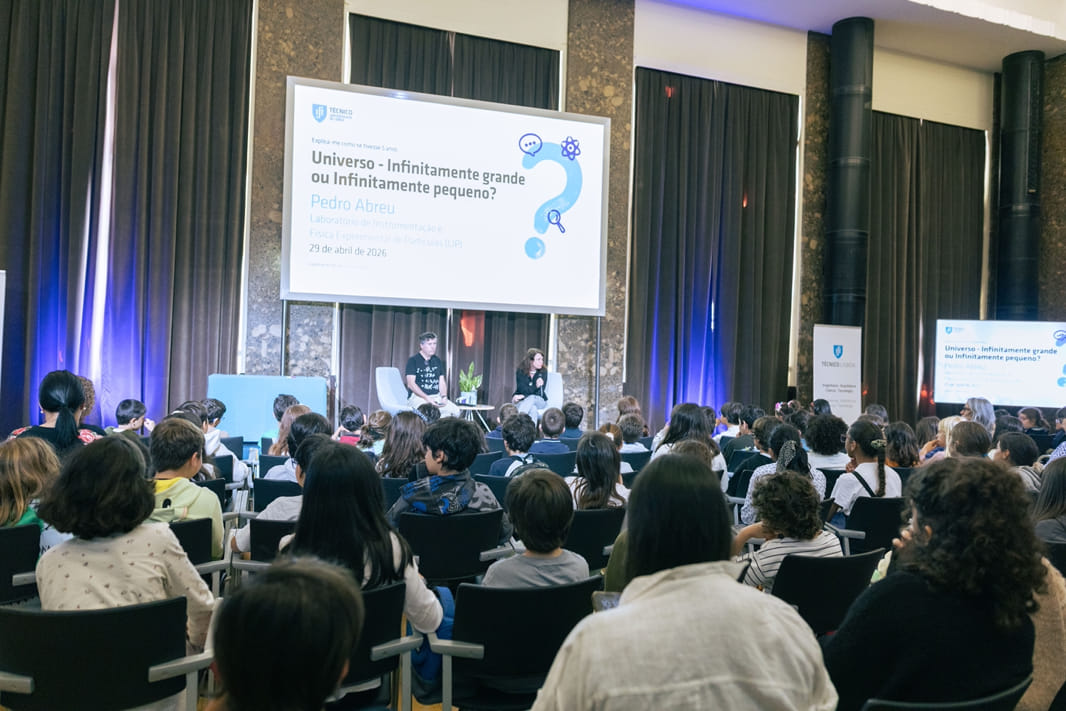
Créditos da foto: IST
Pedro Abreu destacou ainda que grande parte do Universo continua por compreender: apenas cerca de 5% corresponde à matéria feita de átomos, permanecendo a natureza da matéria escura e da energia escura como um dos grandes desafios da física atual. “A ciência avança precisamente porque há perguntas sem resposta”, sublinhou, deixando aos participantes mais novos o desafio de continuarem a procurar respostas — talvez, no futuro, estudando Física no Técnico. | |
| |
Roger Blandford no DFNo âmbito do Programa de Visitantes Internacionais, o DF recebeu, nos dias 5, 8 e 11 de junho, o Professor Roger Blandford, da Universidade de Stanford, que lecionou o mini-curso “Black Hole Gravity, Electrodynamics and Optics”. Ao longo de três aulas, o mini-curso explorou de que forma observações recentes, realizadas em todo o espectro electromagnético e para além dele, têm vindo a confirmar e, simultaneamente, a transformar a nossa compreensão do papel dos buracos negros na origem de algumas das fontes cósmicas mais extraordinárias. Foram discutidos os principais processos físicos envolvidos, com particular destaque para a relatividade geral, a física de plasmas relativistas e a ótica geométrica, bem como a sua aplicação à interpretação de observações recentes e futuras de buracos negros de massa estelar e supermassivos. 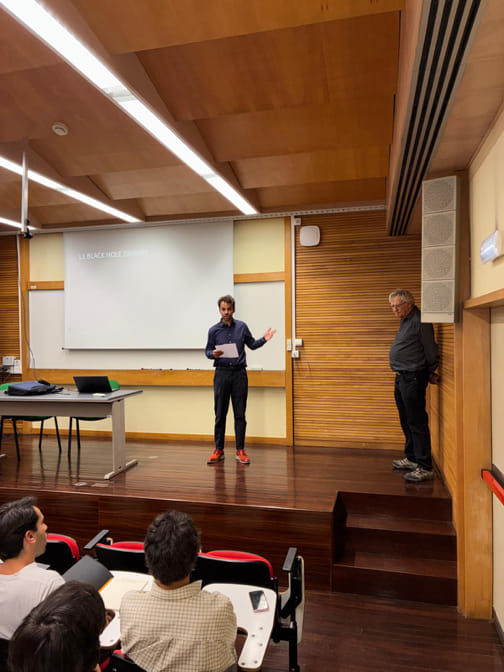 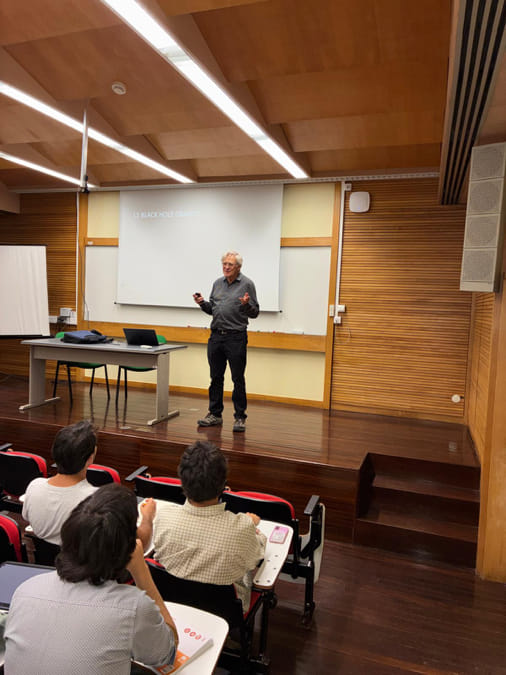
O mini-curso deu particular destaque aos buracos negros associados a M87, SS433 e ao Centro Galáctico, permitindo aos participantes relacionar conceitos teóricos fundamentais com fenómenos astrofísicos observacionais de grande atualidade. As aulas pautaram-se também por notas de humor que contribuíram para tornar a exposição mais leve e acessível. 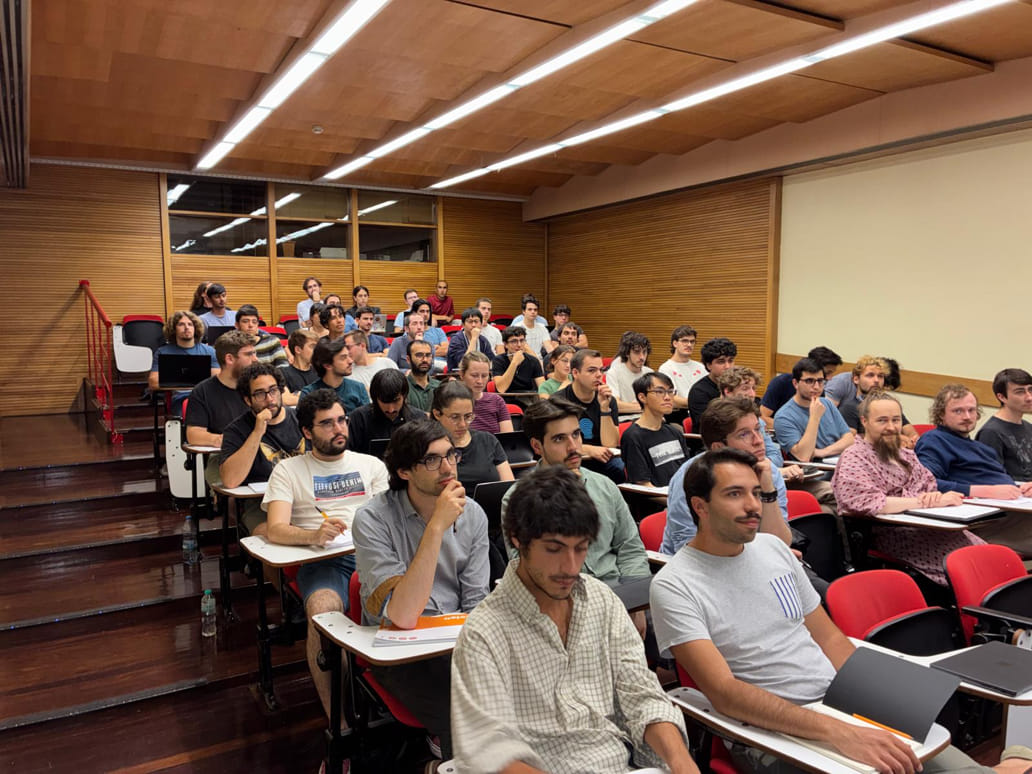
Roger Blandford é Professor Luke Blossom na School of Humanities and Sciences da Universidade de Stanford e Director da Simons Collaboration on Extreme Electrodynamics of Compact Sources. É co-autor, com Kip Thorne, do manual Modern Classical Physics, uma referência abrangente em física clássica moderna. Os seus interesses de investigação incluem astrofísica de estrelas de neutrões e buracos negros, raios cósmicos, cosmologia, lentes gravitacionais e astrobiologia. É Fellow da Royal Society, da American Academy of Arts and Sciences e da American Physical Society, e membro da National Academy of Sciences. Recebeu, entre outros reconhecimentos, o Prémio Dannie Heineman da American Astronomical Society em 1998, a Medalha de Ouro da Royal Astronomical Society em 2013, o Prémio Crafoord para Astronomia em 2016 e o Prémio Shaw para Astronomia em 2020.
| |
| |
Ex-aluna da LEFT vence o prestigiado prémio Vera Rubin New Frontiers 2026Carolina Figueiredo, antiga aluna de Engenharia Física Tecnológica (LEFT) do Instituto Superior Técnico e atualmente doutoranda na Universidade de Princeton, venceu a primeira edição do Prémio Vera Rubin New Frontiers 2026, uma distinção internacional atribuída pela Breakthrough Prize Foundation a investigadoras em início de carreira com contributos relevantes para a física. 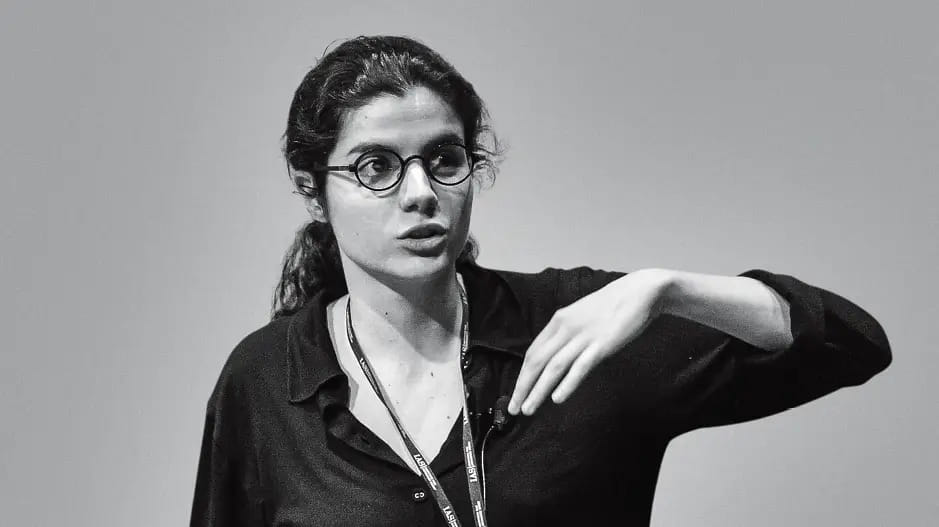
O prémio, no valor de 50 mil dólares, reconhece o impacto do trabalho desenvolvido por Carolina Figueiredo na área da física teórica, em particular nas amplitudes de dispersão e nas relações geométricas ocultas entre teorias quânticas de campos.
A cerimónia de entrega realizou-se no dia 26 de abril, nos Estados Unidos. A distinção foi também assinalada em Portugal, com o Presidente da República, António José Seguro, a felicitar a cientista portuguesa, considerando o prémio um motivo de orgulho nacional. Com este reconhecimento, Carolina Figueiredo junta-se a um grupo de ex-estudantes de Eng. Física Tecnológica distinguidos/as pela originalidade e relevância do seu trabalho, projetando também a formação científica dos/das nossos/as alunos/as no panorama mundial da física fundamental. | |
| |
2nd IST-Physics Frontier Symposium - PhysFront’26No dia 16 de setembro de 2026 terá lugar, no Técnico Innovation Center (TIC), o PhysFront’26 — 2nd IST-Physics Frontier Symposium. À semelhança da edição do ano passado que juntou mais de 300 participantes, este simpósio tem como objetivo divulgar e dar visibilidade à investigação realizada nas diferentes áreas científicas do Departamento de Física, reunindo Professor@s, Investigador@s e Alun@s num dia dedicado à partilha do trabalho desenvolvido no DF e à discussão de novas oportunidades científicas. 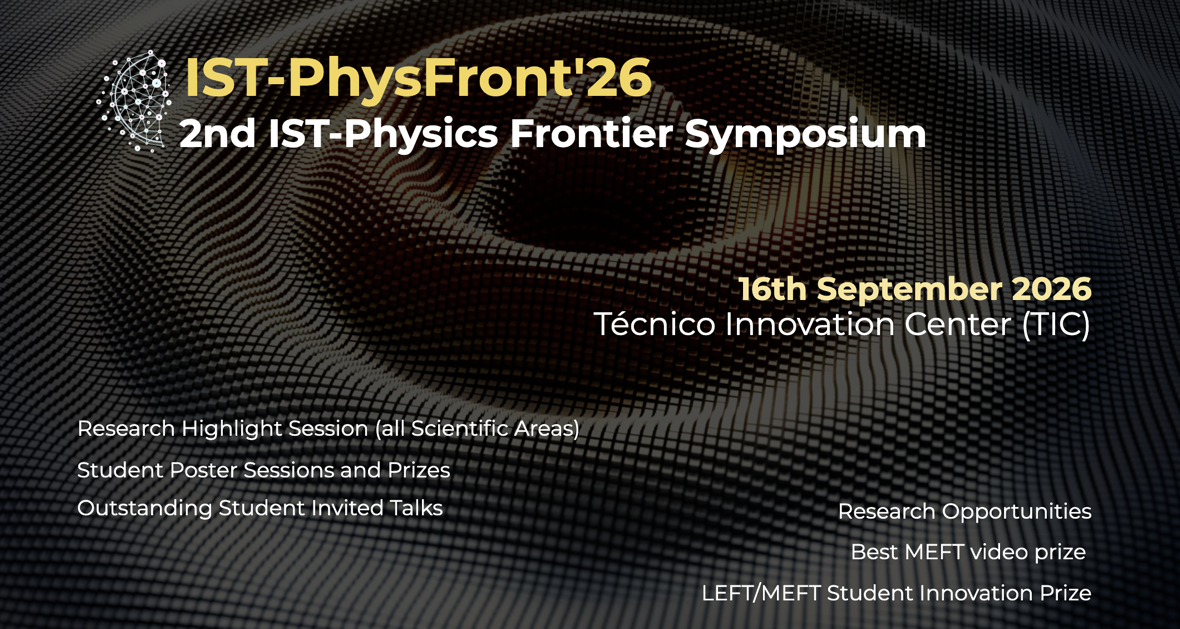
O programa incluirá uma sessão para destaques da investigação aberta a todas as áreas científicas, sessões de posters de estudantes, prémios, apresentações convidadas de estudantes destacados e momentos dedicados à divulgação de oportunidades de investigação. O evento contará ainda com a atribuição do prémio para o melhor vídeo MEFT e do LEFT/MEFT Student Innovation Prize. À semelhança da edição anterior, pretende-se que este seja um momento de encontro de toda a comunidade DF, promovendo a interação entre estudantes dos vários ciclos de estudo, docentes e investigadores, e dando particular destaque ao talento e à participação ativa d@s noss@s estudantes. As informações relativas à submissão de posters e demais detalhes do programa serão enviadas a toda a comunidade do DF brevemente na página web do evento. Contamos com a colaboração e participação de tod@s para fazer do IST-PhysFront’26 um grande evento para o nosso Departamento. Guardem a data nas vossas agendas! O registo para participação já está aberto AQUI. | |
| |
Estudo Acompanhado nas Físicas BásicasA convite do Professor Miguel Teixeira, Presidente do Conselho Pedagógico (CP) do IST, o DF apresentou os resultados do programa "Estudo Acompanhado" na reunião plenária do CP de 21 de maio. Esta iniciativa foi criada para reforçar o apoio pedagógico aos/às estudantes das UCs da Área Científica de Físicas e Tecnologias Básicas, promover o estudo autónomo e melhorar os resultados da aprendizagem. Esta primeira implementação ocorreu durante o ano letivo de 25/26, em quatro UCs de Física básica dos curricula da LEIC-A (Física II), da LEEC (Física I com Laboratório e Física III) e da LETI (Mecânica e Ondas). 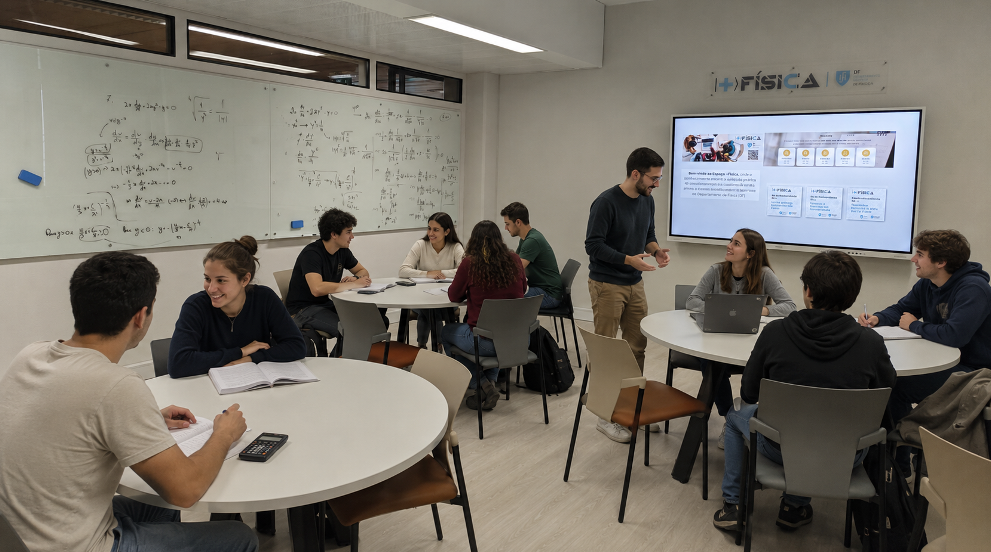
A apresentação, realizada pelo Professor Filipe Joaquim, serviu para partilhar os resultados desta fase piloto, na qual participaram 480 alunos(as), de um total de cerca de 800 inscritos(as) nas quatro UCs. As respostas a um inquérito realizado aos/às participantes evidenciam a grande qualidade das sessões de estudo acompanhado no Espaço +Física e o seu contributo para uma melhor compreensão da matéria. Foi também valorizada a oportunidade de resolver problemas num ambiente colaborativo e de tirar dúvidas.
As opiniões recolhidas junto dos membros do CP, professores/as e alunos/as foram muito positivas e elogiosas, convergindo num ponto: a procura ultrapassou a oferta. Esta limitação poderá ser ultrapassada com mais espaços, como o +Física, e com o reforço do número de colaboradores docentes nas sessões mais concorridas. O Presidente do CP "saudou a iniciativa e o arrojo do Departamento de Física, que se destaca claramente como um dos motores da inovação pedagógica no Técnico, dando o exemplo a toda a instituição e estimulando, pelo seu dinamismo, a reflexão e a ação do próprio Conselho Pedagógico”. Os docentes do DF que pretendam adotar o Estudo Acompanhado na sua UC no próximo 1.º semestre devem contactar a Comissão Executiva. | |
| |
DF no dia do TécnicoA sala principal do Técnico Innovation Center powered by Fidelidade encheu-se, no dia 22 de maio, para assinalar os 115 anos do IST. Perante cerca de mil pessoas, entre estudantes, docentes, familiares e amigos, o Dia do Técnico 2026 distinguiu centenas de estudantes e docentes pelo seu percurso académico e pela excelência demonstrada. 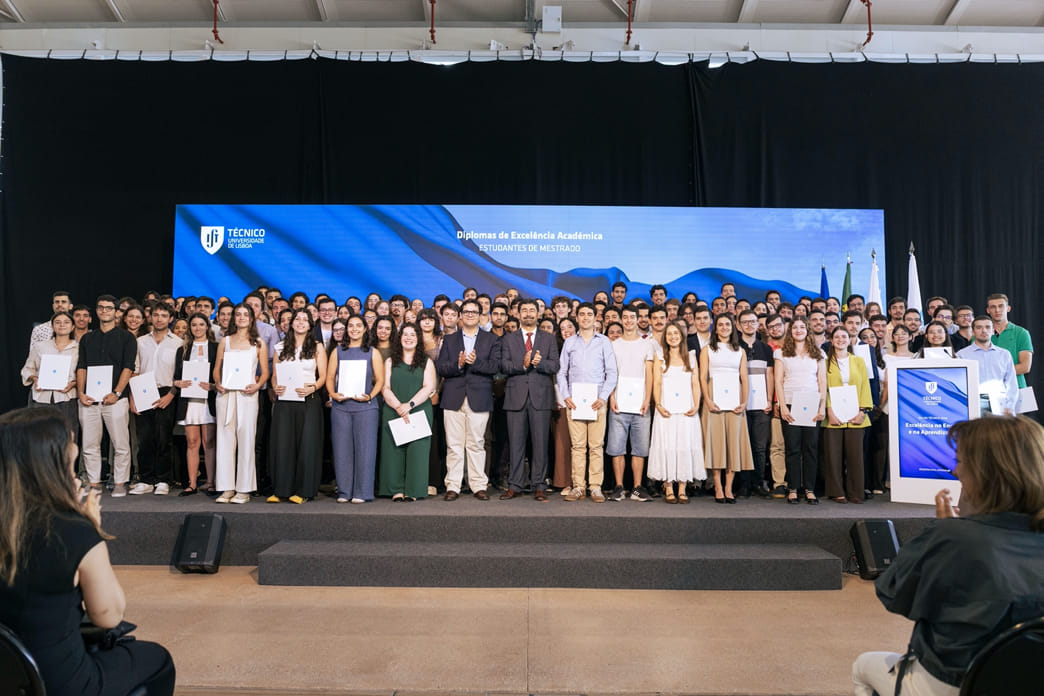
Alunos de Licenciatura distinguidos com Diplomas de Excelência Académica. Créditos da foto: IST A cerimónia destacou a distinção de 531 Docentes Excelentes e de 439 estudantes reconhecidos com Diplomas de Excelência Académica. Comparando a comunidade do Técnico a uma grande família, unida pelo “orgulho” e pelo “amor à camisola”, o Professor Miguel Teixeira (Presidente do Conselho Pedagógico do IST) sublinhou a importância do diálogo sem “extremismos” e terminou com uma nota de confiança: “Podemos estar descansados: passado glorioso, presente excelente e o futuro do Técnico, com esta comunidade, excecional”. 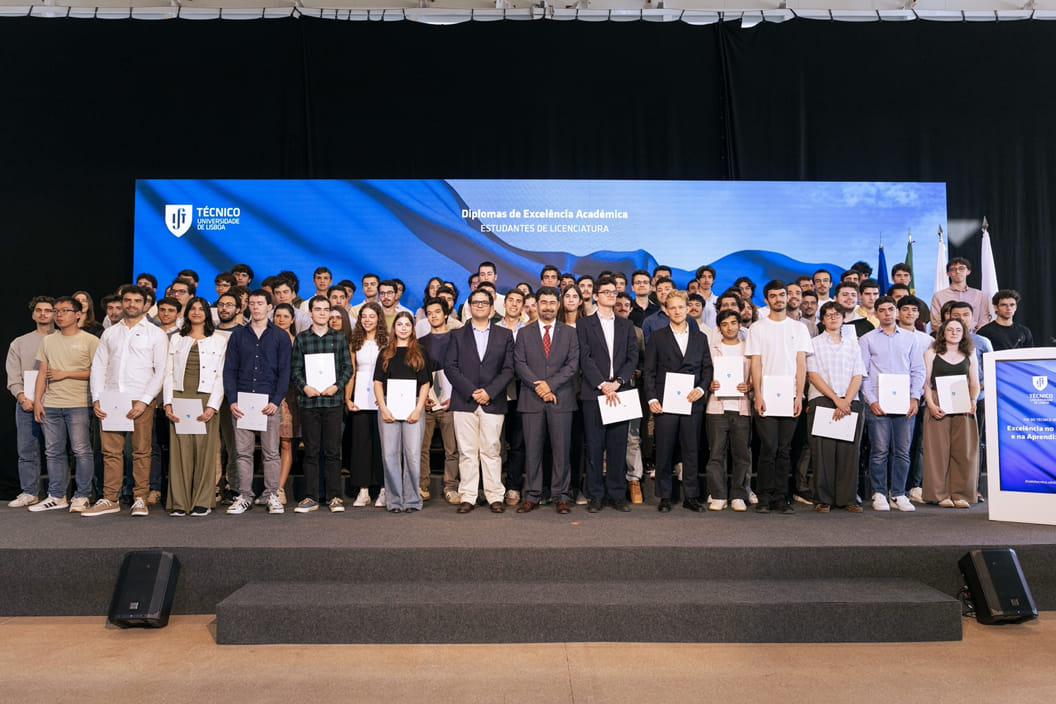
Alunos de Mestrado distinguidos com Diplomas de Excelência Académica. Créditos da foto: IST O DF esteve fortemente representado nesta entrega de distinções. No total, foram atribuídos diplomas de excelência académica a 34 alun@s da LEFT e 45 do MEFT. Os docentes reconhecidos pela excelência no ensino foram 67. Estes resultados são motivo de grande orgulho para o DF e refletem a qualidade, o talento e o compromisso da nossa comunidade. 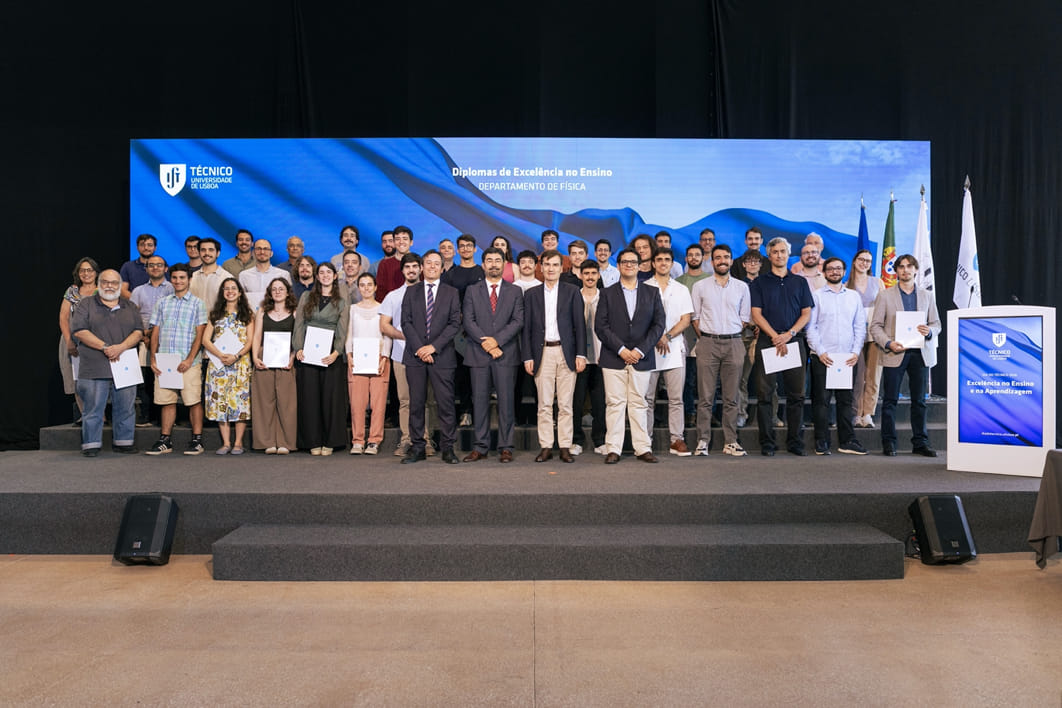
Docentes do DF distinguidos com Diplomas de Excelência no Ensino. Créditos da foto: IST Deixamos uma palavra de agradecimento a todos os estudantes e docentes distinguidos, bem como a todos os que, com dedicação, exigência e entusiasmo, contribuem diariamente para afirmar a excelência do DF. | |
| |
Visita do Professor Nikolay Britun ao DFO DF irá receber o Professor Nikolay Britun, da Universidade de Nagoya, no Japão, no âmbito do Programa de Visitantes Internacionais. Durante a sua estadia, Nikolay Britun irá lecionar o mini-curso “Visualizing Plasma Particles with Light”, composto por três aulas, que terão lugar nos dias 23, 25 e 29 de junho de 2026. 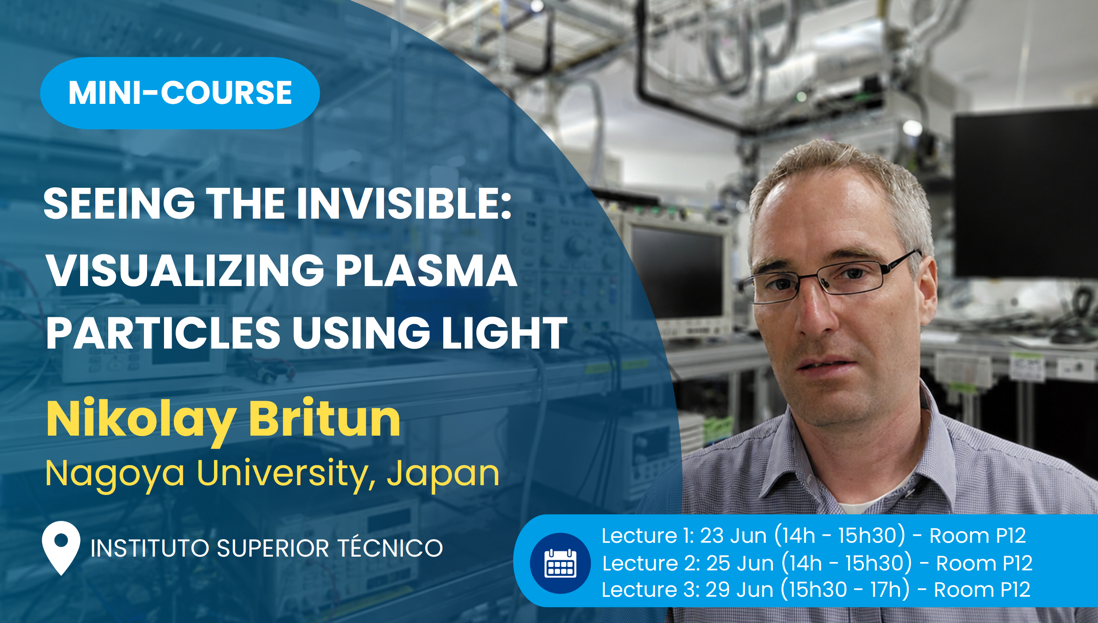
O mini-curso será dedicado à espectroscopia óptica aplicada ao diagnóstico de plasmas, mostrando como a luz pode ser utilizada para obter informação detalhada sobre propriedades e dinâmicas microscópicas que não são diretamente observáveis. Ao longo das três aulas, serão abordadas técnicas de emissão óptica, absorção óptica e métodos baseados em lasers, com recurso a exemplos experimentais reais que ilustram a sua aplicação em investigação de ponta. Nikolay Britun é Professor Associado no Centre for Low-temperature Plasma Sciences da Universidade de Nagoya e um especialista internacionalmente reconhecido em espectroscopia de plasmas. A sua investigação centra-se no desenvolvimento e aplicação de métodos ópticos para medir e compreender propriedades fundamentais dos plasmas, incluindo a dinâmica das partículas e as suas densidades numéricas. Com mais de 100 publicações científicas e vasta experiência no ensino de cursos especializados, alia uma sólida competência científica a uma forte ligação à prática experimental. As inscrições estão abertas aqui até dia 20 de junho. | |
| |
Calendário do DF (Próximos Eventos)- Sessão Plenária do Conselho do DF (17 de junho, 12h30, anfiteatro PA1).
- Almoço convívio (17 de junho, 13h30, sala P8) para todos os professores, investigadores e funcionários não docentes do DF.
- Sessão Plenária do DF - Comissão de Espaços (24 de junho, 11h30, Anfiteatro Abreu Faro)
| | | |
|
|
|
| |
ISóTopos team at the PLANCKS 2026 competitionIST's Engineering Physics was represented at PLANCKS 2026 by the ISóTopos team, composed of João Goulão, Tomás da Costa, José Miguel Xavier and Filipe Miguel Rodrigues, LEFT/MEFT students. Their participation was supported by the Department of Physics and organised by the Portuguese Association of Physics Students (PHYSIS). The international Physics competition, aimed at undergraduate and master’s students, took place from 21 to 25 May in Eindhoven, the Netherlands, bringing together participants from several countries in a programme that included the competition itself, invited lectures, company visits and networking activities.
According to the students, taking part in PLANCKS 2026 was “an unforgettable experience”, marked by contact with people from different cultures brought together by a shared interest in Physics. The team highlighted, in particular, the lectures on photonics and its importance in today’s industry, an area with a strong presence in the Eindhoven region, as well as the visit to the University of Twente, where they had the opportunity to meet representatives of companies connected to this sector.
The four-hour competition was considered both challenging and stimulating. The students highlighted the spirit of cooperation throughout the problem-solving process, although they noted that the test had a strong optics component and placed less emphasis on areas such as electromagnetism or statistical physics. Although the results fell short of expectations (39th place out of 54 teams), the team considers this first participation to have been a very positive experience and an important learning opportunity for future editions. As they summarised in their testimony, “PLANCKS is much more than an exam”, offering a unique opportunity for learning, sharing and socialising among Physics students from around the world. | | | |
| | FLASHGuard makes history at MIT and strengthens its international presence
The FLASHGuard project, developed by LIP through the Particles4Health group, in partnership with RTBeamTech and Instituto Superior Técnico, became the first Portuguese team and the first foreign project to reach the final of the prestigious MIT $100K Entrepreneurship Competition, one of the world’s leading university entrepreneurship competitions.
From left to right in the photo: Gonçalo Roriz, Manuel Ratola, Prof. Pedro Assis and Gonçalo Ribeiro.
After winning MIT $100K Portugal, the team represented the country in Boston, presenting its technology to investors, entrepreneurs and global innovation leaders. Its growing international visibility was further strengthened by a meeting in Brussels with Momchil Sabev, Director of EISMEA, the European Innovation Council and SMEs Executive Agency, to present FLASHGuard’s progress and potential impact, as well as by its participation in the EIC Summit 2025.
In recent months, the project has received several distinctions, including the CaixaImpulse Health Innovation Stage 1 Grant, Lab2Market@Técnico 2025, LISPOLIS Ignite 2025 and Europe’s Youth Start-Up Competition 2025. This trajectory highlights Portugal’s ability to transform excellent scientific research into innovation with global impact in the field of health. | | | |
| | New Physics Laboratories at Técnico: a new stage in experimental teaching
Since the inauguration, in January 2026, of the new Physics Laboratories at Instituto Superior Técnico, the Department of Physics has had access to a benchmark infrastructure for the experimental teaching of Physics. These new spaces were designed to support curricular teaching, creating better conditions for active, rigorous learning closely aligned with contemporary scientific and technological practice.
The implementation of this infrastructure is the result of a sustained effort over several years, involving successive Department presidencies, many faculty members and technical staff, as well as the institutional support of Técnico. Its full use now requires a clear and sustainable governance model, capable of bringing together pedagogical vision, technical operation and future development.
In this context, two complementary directorships have been created. Professor Marco Piccardo takes on the role of Pedagogical Director of the IST Physics Laboratories, with responsibility for the pedagogical strategy of experimental teaching, the quality of laboratory activities and the curricular coordination of the teaching units that use these spaces. Professor Susana Freitas takes on the role of Operational Director of the IST Physics Laboratories, with responsibility for day-to-day operation, maintenance, safety, technical management and infrastructure development.
Working in close collaboration with each other, with the Department Presidency and with colleagues, technical staff and students, these directorships will seek to ensure that the new laboratories become a dynamic ecosystem for teaching, experimentation and innovation, serving students and the wider Técnico academic community.
| |
| |
Universe — Infinitely large or infinitely small?
In the April session of the “Explain it to me like I’m 5” initiative, Pedro Abreu, Professor at the Department of Physics and researcher at LIP, took participants on a journey between the infinitely large and the infinitely small, starting from an apparently simple question: what are things made of? Beginning with the Sun, the stars and galaxies, the session showed how science has expanded our view of the Universe, with the help of instruments such as telescopes. Then, shifting scale, the researcher moved on to the world of microscopes, atoms and fundamental particles, explaining how accelerators such as the Large Hadron Collider at CERN act as “giant microscopes” capable of revealing the deepest structure of matter.
Photo credits: IST Pedro Abreu also highlighted that much of the Universe remains to be understood: only around 5% corresponds to matter made of atoms, while the nature of dark matter and dark energy remains one of the great challenges of contemporary physics. “Science advances precisely because there are unanswered questions,” he emphasised, leaving the younger participants with the challenge of continuing to search for answers — perhaps, in the future, by studying Physics at Técnico. | |
| |
Roger Blandford at DFAs part of the International Visitors Programme, the Department of Physics welcomed Professor Roger Blandford, from Stanford University, on 5, 8 and 11 June. During his visit, he delivered the mini-course “Black Hole Gravity, Electrodynamics and Optics”. Over the course of three lectures, the mini-course explored how recent observations, across the entire electromagnetic spectrum and beyond, have been confirming and, at the same time, transforming our understanding of the role of black holes in powering some of the most extraordinary cosmic sources. The main physical processes involved were discussed, with particular emphasis on general relativity, relativistic plasma physics and geometrical optics, as well as their application to the interpretation of recent and future observations of stellar-mass and supermassive black holes. The mini-course placed particular emphasis on the black holes associated with M87, SS433 and the Galactic Centre, allowing participants to connect fundamental theoretical concepts with highly topical observational astrophysical phenomena. The lectures were also marked by moments of humour, which helped make the presentation lighter and more accessible.
Roger Blandford is the Luke Blossom Professor in the School of Humanities and Sciences at Stanford University and Director of the Simons Collaboration on Extreme Electrodynamics of Compact Sources. He is co-author, with Kip Thorne, of Modern Classical Physics, a comprehensive reference textbook in modern classical physics. His research interests include the astrophysics of neutron stars and black holes, cosmic rays, cosmology, gravitational lensing and astrobiology. He is a Fellow of the Royal Society, the American Academy of Arts and Sciences and the American Physical Society, and a member of the National Academy of Sciences. Among other distinctions, he received the Dannie Heineman Prize of the American Astronomical Society in 1998, the Gold Medal of the Royal Astronomical Society in 2013, the Crafoord Prize in Astronomy in 2016 and the Shaw Prize in Astronomy in 2020. | |
| |
Former LEFT student wins the prestigious Vera Rubin New Frontiers Prize 2026Carolina Figueiredo, a former student of Engineering Physics at Instituto Superior Técnico and currently a PhD student at Princeton University, has won the Vera Rubin New Frontiers Prize 2026, an international distinction awarded by the Breakthrough Prize Foundation to early-career women researchers who have made significant contributions to physics.
The prize, worth 50,000 dollars, recognises the impact of Carolina Figueiredo’s work in theoretical physics, particularly in scattering amplitudes and the hidden geometric relations between quantum field theories. The award ceremony took place on 26 April in the United States. The distinction was also recognised in Portugal, with the President of the Republic, António José Seguro, congratulating the Portuguese scientist and describing the prize as a source of national pride. With this recognition, Carolina Figueiredo joins a group of former Engineering Physics students distinguished for the originality and relevance of their work, further projecting the scientific training of our students onto the global stage of fundamental physics. | |
| |
2nd IST-Physics Frontier Symposium - PhysFront’26On 16 September 2026, the Técnico Innovation Center (TIC) will host PhysFront’26 — the 2nd IST-Physics Frontier Symposium. Following last year’s edition, which brought together more than 300 participants, this symposium aims to promote and give visibility to the research carried out across the different scientific areas of the Department of Physics, bringing together faculty members, researchers and students for a day dedicated to sharing the work developed within the Department and discussing new scientific opportunities.
The programme will include a research highlights session open to all scientific areas, student poster sessions, prizes, invited presentations by outstanding students, and moments dedicated to presenting research opportunities. The event will also include the award for the best MEFT video and the LEFT/MEFT Student Innovation Prize. As in the previous edition, the aim is for this to be a moment of encounter for the entire Department of Physics community, promoting interaction between students from the different study cycles, faculty members and researchers, while placing particular emphasis on the talent and active participation of our students. Information regarding poster submission and further programme details will soon be made available to the Department of Physics community on the event webpage. We count on everyone’s collaboration and participation to make IST-PhysFront’26 a major event for our Department. Save the date! Registration is already open HERE. | |
| |
"Guided Study" in Basic PhysicsFollowing the invitation of Professor Miguel Teixeira, President of IST’s Pedagogical Council (CP), the Department of Physics presented the results of the “Guided Study” programme at the CP plenary meeting held on 21 May. This initiative was created to strengthen pedagogical support for students enrolled in course units within the Scientific Area of Basic Physics and Technologies, to promote autonomous study and to improve learning outcomes. This first implementation took place during the 2025/26 academic year, in four basic Physics course units from the curricula of LEIC-A (Physics II), LEEC (Physics I with Laboratory and Physics III) and LETI (Mechanics and Waves).
The presentation, delivered by Professor Filipe Joaquim, served to share the results of this pilot phase, in which 480 students took part, out of a total of around 800 enrolled in the four course units. The responses to a survey carried out among the participants highlight the very high quality of the guided study sessions at Espaço +Física and their contribution to a better understanding of the material. The opportunity to solve problems in a collaborative environment and to ask questions was also highly valued. The feedback gathered from members of the Pedagogical Council, faculty members and students was very positive and complimentary, converging on one point: demand exceeded supply. This limitation could be addressed with more spaces, such as +Física, and by increasing the number of teaching staff involved in the most popular sessions. The President of the Pedagogical Council “welcomed the initiative and boldness of the Department of Physics, which clearly stands out as one of the drivers of pedagogical innovation at Técnico, setting an example for the whole institution and, through its dynamism, stimulating reflection and action within the Pedagogical Council itself”. Department of Physics faculty members wishing to adopt Guided Study in their course unit in the next first semester should contact the DF's Executive Committee. | |
| |
The Department of Physics at Técnico DayThe main hall of the Técnico Innovation Center powered by Fidelidade was filled on 22 May to mark IST’s 115th anniversary. Before an audience of around one thousand people, including students, faculty members, families and friends, Técnico Day 2026 honoured hundreds of students and faculty members for their academic achievements and demonstrated excellence.
Undergraduate students distinguished with Academic Excellence Diplomas. Photo credits: IST The ceremony highlighted the recognition of 531 Excellent Faculty Members and 439 students awarded Academic Excellence Diplomas. Comparing the Técnico community to a large family, united by “pride” and “love for the institution”, Professor Miguel Teixeira, President of IST’s Pedagogical Council, underlined the importance of dialogue without “extremes” and ended on a note of confidence: “We can rest assured: a glorious past, an excellent present and, with this community, an exceptional future for Técnico.”
Master’s students distinguished with Academic Excellence Diplomas. Photo credits: IST The Department of Physics was strongly represented in this awards ceremony. In total, Academic Excellence Diplomas were awarded to 34 LEFT students and 45 MEFT students. A total of 67 faculty members and teaching assistants were recognised for excellence in teaching. These results are a source of great pride for the Department of Physics and reflect the quality, talent and commitment of our community.
Department of Physics faculty members distinguished with Teaching Excellence Diplomas. Photo credits: IST We extend our thanks to all the students, faculty members and collaborators who were distinguished, as well as to everyone who, with dedication, rigour and enthusiasm, contributes every day to affirming the excellence of the Department of Physics. | |
| |
Visit of Professor Nikolay Britun to the Department of PhysicsThe Department of Physics will welcome Professor Nikolay Britun, from Nagoya University, Japan, as part of the International Visitors Programme. During his stay, Nikolay Britun will deliver the mini-course “Visualizing Plasma Particles with Light”, consisting of three lectures, which will take place on 23, 25 and 29 June 2026.
The mini-course will focus on optical spectroscopy applied to plasma diagnostics, showing how light can be used to obtain detailed information about microscopic properties and dynamics that are not directly observable. Over the three lectures, optical emission techniques, optical absorption and laser-based methods will be addressed, using real experimental examples to illustrate their application in cutting-edge research. Nikolay Britun is an Associate Professor at the Centre for Low-temperature Plasma Sciences at Nagoya University and an internationally recognised expert in plasma spectroscopy. His research focuses on the development and application of optical methods to measure and understand fundamental plasma properties, including particle dynamics and number densities. With more than 100 scientific publications and extensive experience in teaching specialised courses, he combines strong scientific expertise with a close connection to experimental practice. Registration is open here until 20 June. | |
|
|
|
| |
DF Calendar (Upcoming Events)- DF Council Plenary session (June 17, 12h30, PA1 amphitheatre)
- Convivial lunch (June 17, 13h30, room P8) for all DF professors, researchers and non-teaching staff.
- DF Council Plenary session - DF Spaces Committee (June 24, 11h30, Abreu Faro amphitheatre)
| | | |
|
|
|
|